 As a soldier, Roger Morgan-Grenville served in 5 continents, including the sub-Antarctic. After running a small housewares business, he turned to full time writing and campaigning in 2016. He has published 7 books of which the most recent is The Restless Coast (reviewed here), and was a founder member of the charities Help for Heroes and Curlew Action.
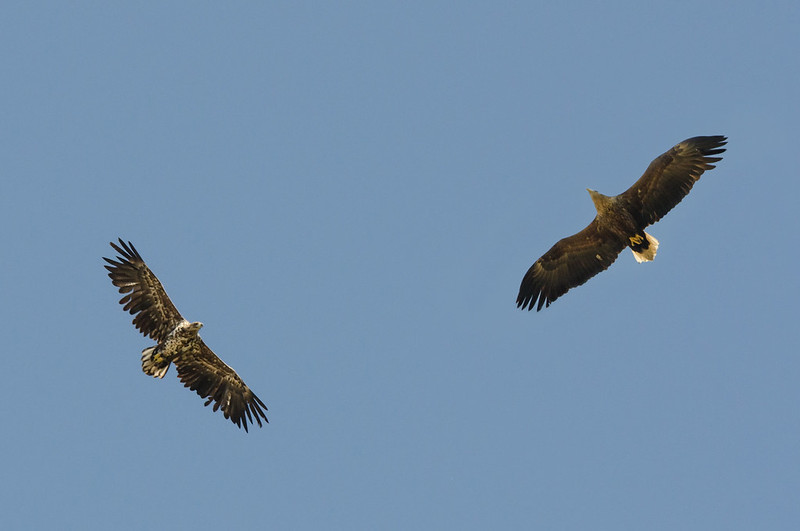
White-tailed Eagles are back in the news again, and not really for the right reasons.
Last autumn it was the dastardly birds (5 kg) allegedly carrying off Shetland Ponies (17-20kg at birth) in the Outer Hebrides, a story that you might have thought ridiculous enough not to have been given air-time on Radio 4’s The World at One. And yet it was. Now it is the prospect of a reintroduction to Cumbria which comes with stark warnings in local papers about how the birds may come for your pet, even your young children, once they have finished with the sheep. What to say? Where, even, to start? In de-natured Britain, it is so much easier to hold a strong opinion than it is to harvest boring facts.
The White-tailed Eagle is primarily a kleptoparasite, meaning that its preferred method of feeding is to let others do the killing, and then to rob them. I have watched otters, gannets and gulls all being mugged in this way. In this, and in its habit of scavenging roadkill, for example, it could be considered closer to a vulture in behaviour than it is to, say, a Golden Eagle. However, it is also, like all raptors, a consummate opportunist, which means that it will also actively hunt if it is hungry enough and the hunting sufficiently easy. The victims can occasionally be lambs or piglets, and not just sick ones, and there is no point in us pretending otherwise. There is no reliable evidence as to how many healthy livestock are taken by White-tails each year and, surprisingly, no verified video evidence of it happening; however, the numbers are almost certainly small, as you would expect in a country of 30 million sheep and just 200 pairs of White-tailed eagles who have plenty of their primary diet of seabirds and fish available. These figures may be small, but they are significant enough to cause meaningful loss of income and precious genetics to affected farmers. Pretending it doesn’t happen at all, or that it doesn’t really matter when it does, is not helpful. But exaggerating it is just as bad.
As part of my book research for a story of the White-tailed Eagle in Britain, I have just spent a week in Norway having also spent time on the islands of Rum, Mull and Wight, with their own deep connections to the tale. The journey was partly above the Arctic Circle to get a feel for where the original Rum reintroduction birds came from, and partly down south, near Alesund, to see for myself how sheep live alongside a high density of both the White-tailed and the Golden, eagle. The archipelago I chose is one that hosts no less than 70 pairs of White-tails, and probably the same number of Golden Eagles, in an area rather smaller than West Sussex. Despite visiting and interviewing eight farmers, I could not find one who had lost a single sheep to an eagle. Or, indeed, who knew of any neighbouring farmer who had. To emphasise the point, two of my interviews were conducted standing immediately below an active White-tail nest, and immediately above a paddock with small lambs in it. (The sheep in question are a traditional breed Old Norse, who provide for good eating but even better wool, hence the desirability of Norwegian sweaters.)
So what is different? It’s hard to say, but probably not a whole lot. Possibly the alternate food source is more reliable in Norway although, as far as seabirds are concerned, I would find this highly unlikely. Possibly traditional breeds fare better with a predator with whom they are familiar and to whom they may display greater confidence. Possibly the darker colour of the Norse sheep makes a difference; anecdotally this was the case with one farmer I spoke to on Mull, who had farmed both black and white sheep. Certainly, the flocks I saw in Norway were smaller, and more easily and more often visited, than many of the ones I came across in Scotland; indeed, ‘black loss’ (which means the unexplained death and disappearance of lambs) was almost unheard of among the Norwegian farmers I spoke to. Certainly, the available compensation scheme in Norway is considered generous, simple and quick, which is not at all how its Scottish equivalent is seen. And certainly, the coexistence of eagles and sheep is not the conflict zone that it is in the UK. In Britain, the press and social media are jointly culpable for stoking flames irresponsibly and unnecessarily. There shouldn’t be ‘sides’ but, given that there are, all of us should probably use mouths and ears in the proportion with which we are all equipped, rather than reaching for the nearest bored newspaper hack or, worse still, Twitter, to louden the echo chamber of our own viewpoint.
I guess that the challenge is, and will always be, to see what accommodations the super apex-predator (us) are prepared to make to welcome lesser predators back onto our landscape and into our ecosystems. The early signs are not encouraging. Our starting point in terms of our own shifting baselines is close to zero, as that is the number of raptors most of us grew up alongside once DDT, egg collecting, and persecution had done their worst. This means that we now see killers in the sky where there were none before. Some of us like that, but many don’t. Things are better for raptors now, but it is this new abundance that is encouraging many of us to tell anyone who will listen that there are simply ‘too many’ of these things; too many buzzards, too many kites, too many goshawks and, soon, too many eagles. But how many is too many? What is the science behind these opinions? What is the right amount? And, by the way, how do you know?
It is 51 years since the first four eaglets were brought over from Norway to Rum at the start of the project to reintroduce the White-tailed Eagle to Britain. It is another brick in the wall of lost or nearly lost species reintroductions, lying alongside the Red Kite, the Eurasian Beaver and, who knows, one day the Lynx.
But I suspect that to imagine that all this can happen without changes on our own part is wishful thinking.
Mark writes: see also;
The Sea Eagle: was its extinction justified? by John Love, August 2023, click here
RSPB/SOC press release: Lambs not a major food source for breeding White-tailed Eagles in Scotland – click here
[registration_form]
Source link