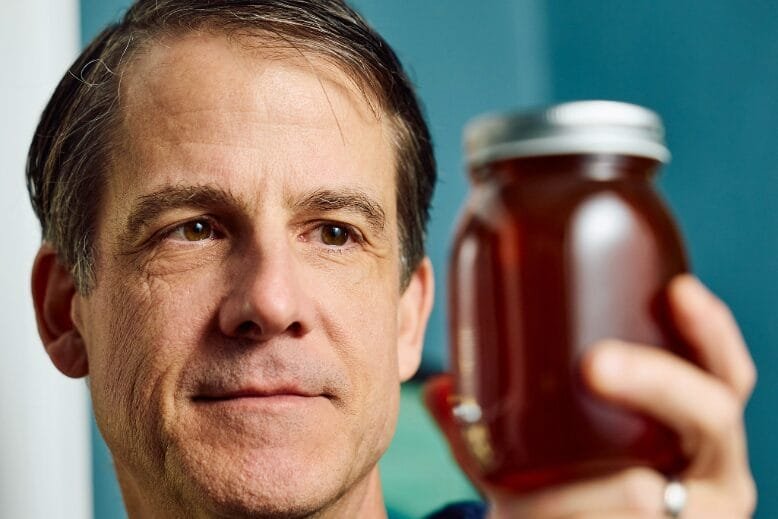
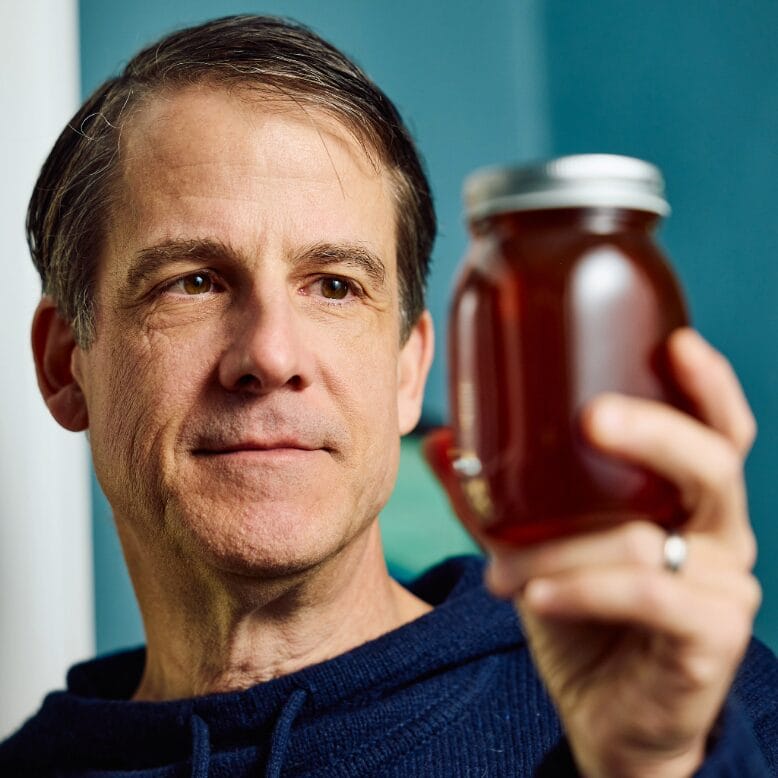
Beekeeper Marc Leckington holds a jar of honey from the bees he keeps in his Trenton backyard. Photo: Matt Zugale
It was a chilly afternoon in late November, but some 50,000 guests in Marc Leckington’s backyard seemed to be warm, happy and snug as they drowsed the day away. “They’re pretty quiet now,’’ said Leckington. “Hopefully, they all survive the winter.’’
Leckington and his wife, Michele, keep bees in the backyard of their tidy Tudor home in Trenton. Michelle says it was just another one of their crazy ideas—something that looked interesting.
After a few false starts and some beekeeping classes, the Leckingtons and their hives started humming. Soon, they were bottling honey every spring and fall, and even selling some to brewers and mead makers. Last year, they harvested some 500 pounds and began selling chunks of raw, ripe honeycomb cut straight from the hive.

The Leckingtons sell their home-grown honey to brewers and mead makers. Photo: Matt Zugale
In every corner of New Jersey, people who’ve never worked a farm or even tilled a garden are husbanding honeybees on rooftops, vacant lots and suburban yards. Enthusiasts estimate there are as many as 4,000 or more amateurs feeding a beekeeping boom that shows no sign of slowing amid the growing demand for fresh, local food.
Many are food artisans and restaurants seeking distinctive and wholesome ingredients.
“Why are so many people drawn to beekeeping? That’s a great question,” says New Jersey state apiarist Meghan McConnell, an entomologist who also operates Holly City Honey Bees in Millville. “There’s just something very rewarding about the rhythm and nature of beekeeping that attracts all kinds of people.”
Of course, there’s also the honey, which has become a homegrown staple for many locavores.
Allison Wachenheim-Tolpa, the former longtime owner of Sweet Cheeks Farm & Apiary in Hunterdon County, says locally made honey has become an essential ingredient in the arsenal of chefs and food artisans. High-end locavore hangouts like Agricola in Morristown sought out her small-batch blends of herb-and flower-infused honey for sauces, marinades, salad dressings and cheese boards.
Bartenders, she says, are always on the hunt for ways to add spice, smokiness or herbal notes to their cocktails. “Honey is far more than a simple sweetener,” she says. “It’s a flavor storyteller.”
Restaurants like the MC Hotel in Montclair have even started their own bee colonies. The Beach Plum Farm in West Cape May also raises its own bees to help pollinate its gardens and provide local honey for guests.
Eleftherios Xenidis, executive chef at the Hyatt Regency Jersey City, says homegrown honey gives urban chefs access to a fresh, local ingredient that cooks in more rural areas take for granted. “In Jersey City, we’re not surrounded by farms and farmers markets where you always know you can easily find great stuff,” he says. “Plus, commercial, mass-produced honey is just garbage.”
Bee wine, otherwise known as mead, is, at its most basic, a fermented mix of honey and water. It’s the world’s oldest known alcoholic beverage, and it happens to be having a moment in New Jersey.
Curtis Blodgett, owner of the Beach Bee Meadery in Beach Haven, offers a half-dozen varieties, including one he ages in Scotch whisky barrels for four years. He’s partial to New Jersey wildflower and red bamboo honey from Stiles, a bee farm in Middlesex County.
Ray Sheehan is a nationally known chef, grill master and cookbook author from New Egypt, a small community in western Ocean County. He’ll talk all day about the importance of local honey—more specifically, Pine Barrens honey. Aficionados say it has an unmistakable herbal finish that comes from the acidic soils feeding native flora like the pepperbush and pitch pine. It’s a distinctly different taste experience from familiar, citrusy orange-blossom honey or other honeys made from the nectar of grassy clover fields.
Sheehan’s search for the perfect honey ended with a pair of beekeepers in Jackson Township. He’s also smitten with a producer from rural Fords in Middlesex County, who supplies the key component of his best-selling condiment, hot honey.
One day early last December, Sheehan sold four full cases of his hot honey concoction at Pop’s farm market in Monroe Township. The secret, he says, is steeping the Fords wildflower honey with mashed chili peppers. “You taste the sweet honey on your lips at first, but then the heat comes on in a wave,” Sheehan says. “Then all of a sudden the heat backs off, and you’re left with the taste of that honey again. It’s an experience.”
Buffs say the essential beauty and mystery of the bee colony is its ability to thrive just about anywhere. Despite the scourge of pests like parasitic mites, and the well-documented impact of pesticides and climate stress on pollinators, healthy bees always find a way to make honey.
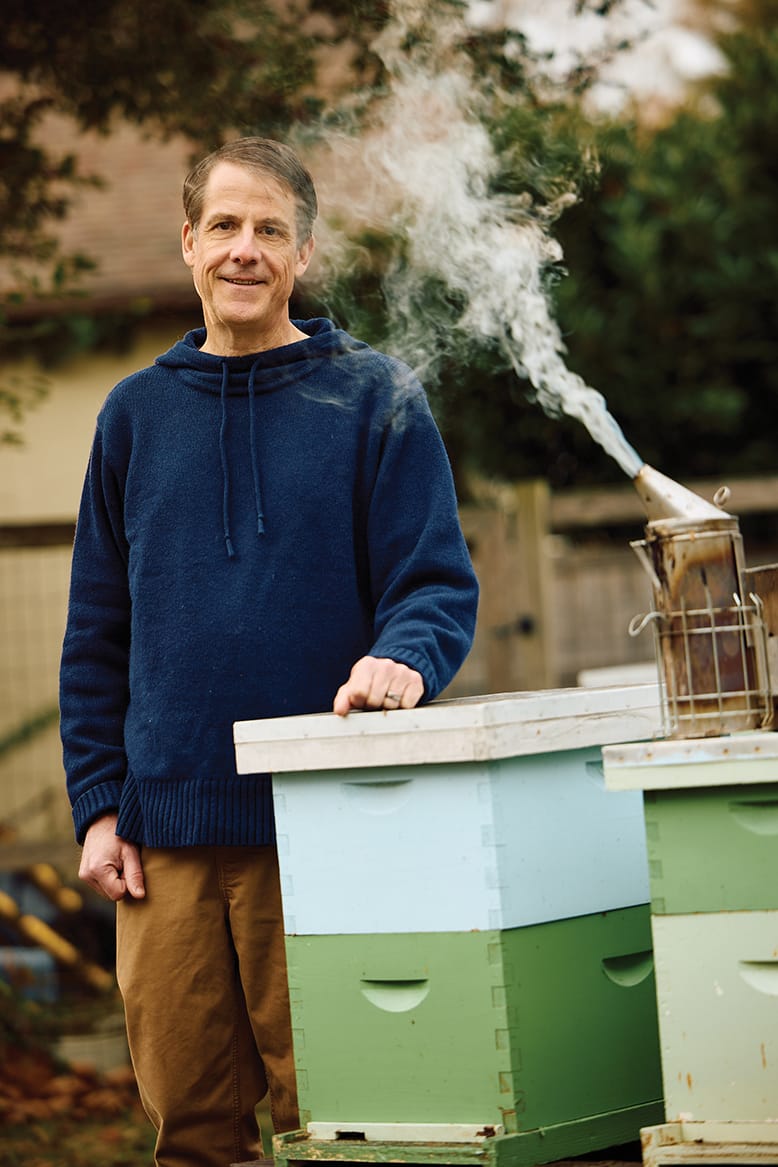
Photo: Matt Zugale
Back in Trenton, Marc Leckington says his bees are active in early spring, as soon as the maples, poplars and dogwoods in nearby Cadwalader Park start to leaf out and blossom. As the weather warms, his bees also drink nectar from the perennial herbs and shrubs in the park and around the Hiltonia neighborhood sitting above the Delaware and Raritan Canal.
From spring until summer, Leckington’s backyard BeeCurious Honey Farm will yield 500 pounds of honey that is delicious, deeply flavored and dusky—not what you’d find in the average supermarket. “It was definitely a great year,” he says.

Plus: A Caribbean chain says goodbye to Jersey, while a lively Peruvian spot comes to Elmwood Park.

The weekend-long celebration will feature tastings, dinners and parties with top chefs and winemakers, plus a lunch hosted by NJM senior editor Jacqueline Mroz.