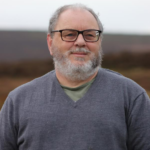
Nick MacKinnon is a freelance teacher of Maths, English and Medieval History, and lives above Haworth, in the last inhabited house before Top Withens = Wuthering Heights. In 1992 he founded the successful Campaign to Save Radio 4 Long Wave while in plaster following a rock-climbing accident on Skye. His poem ‘The metric system’ won the 2013 Forward Prize. His topical verse and satire appears in the Spectator, and his puzzles and problems in the Sunday Times and American Mathematical Monthly. Email: nipmackinnon@gmail.com
Turbine 30 Harry Side Edge SD 99771 33966 ///objecting.tips.cracks

This blog was sent for comment to Tony Juniper the CEO of Natural England, and Christian Egal the Project Director of Calderdale Energy Park. An analytical account of the conflict between the King’s Pennine Gateway NNR and the proposed Calderdale Energy Park has been sent to His Majesty the King.
11 January 2026 There has been the usual snow but then remarkable ice. The dog and I will have a pocket adventure on it later, once we have taken in what Condé Nast Traveller magazine have been saying about Walshaw Moor in the 2026 edition of their annual list The Seven Wonders of the World.
Each year, we set ourselves the task of picking seven wonders of the world for the year to come. The seven wonders of the ancient world included the Colossus of Rhodes, the Lighthouse of Alexandria, and the Hanging Gardens of Babylon and only one – the Great Pyramid of Giza – remains to this day. So, where should travellers be looking to find wonder in the modern age? Below, we list seven wonders of the world for 2026. Happy travelling.
Six of the wonders are Matera (Italy), Banff National Park (Canada), Djemila (Algeria), Faroe Islands, Richtersveld (South Africa) and El Imposible National Park (El Salvador).
These wonders are remarkable, and I envy anyone with the resources and energy to explore El Imposible, with its pumas, king hawks and black-crested eagles.
The seventh wonder of the world is the Bradford Pennines Gateway to Walshaw Moor, sponsored by the King.
One of the reigning monarch’s ongoing King’s Series of nature reserves, the Bradford Pennines Gateway is part of a nationwide initiative to protect and celebrate the UK’s natural heritage, enhance biodiversity, and give local communities better access to nature. Rather like King Charles himself, there’s something stoic and un-showy about this region, resided in, and beloved by, the Brontë sisters and encompassing Ilkley Moor, Penistone Hill Country Park, Harden Moor and Bingley North Bog.
Right on the upland edge where Bradford begins to fray into heathery oblivion, these are landscapes of unhurried drama: undulating moors, wind-polished gritstone [outcrops] and views that collapse into long, moody distances […]. New trails knit the old wool villages of Haworth, Stanbury and Thornton into a tapestry of slow travel, with signposted routes pointing you towards medieval packhorse bridges, secret waterfalls, and a pub or two that still understands a proper pint. If Britain ever needed proof that the everyday could still surprise, the Bradford Pennines Gateway delivers with quiet aplomb.
Tony Juniper the CEO of Natural England, was justifiably elated.
“I was absolutely delighted to see the Bradford Pennine Gateway National Nature Reserve picked out by Conde Nast Traveller as one of Seven Wonders of the World in 2026. We are so proud of the King’s Series of NNRs at Natural England & it’s really great to see this one taking Yorkshire’s breathtaking Nature to the world stage.”
Natural England’s purpose in creating the gateway was laid out in a press release on 13 May 2025, perhaps the heaviest hammerblow to Calderdale Wind Farm’s plans to destroy Walshaw Moor.
Brontë Country to become country’s newest National Nature Reserve. Bradford Pennine Gateway National Nature reserve launched, creating huge boost for countryside access.
One of Britain’s youngest cities is set to benefit from the creation of a huge new national nature reserve – the Bradford Pennine Gateway National Nature Reserve.
The new National Nature Reserve – the seventh in the King’s Series – announced and created today (13 May) is the first of its kind in West Yorkshire and will provide people with opportunity to enjoy the landscapes that inspired and were celebrated by the Brontë Sisters.
The reserve spans 1,272 hectares, twice the size of Ilkley Moor, and links together eight nature sites within the Bradford & South Pennines area, two of which are internationally important upland habitats, and much-loved places such as Penistone Country Park in Haworth, home of the Brontës.
The establishment of this reserve will bridge this gap between the city of Bradford and the countryside by highlighting a range of important habitats just a stone’s throw from people’s homes. A National Nature Reserve next to one of the UK’s youngest cities will also help to break down barriers for young people accessing the countryside in one of England’s most nature deprived areas.
Approximately 90% of the area comprises UK priority habitats, including peat bogs, heathlands, and wetlands. Endangered wildlife such Adders, Curlew, and Golden plover will benefit from greater protections and better-connected habitats. 42% of the reserve will be newly protected, with 738 hectares (58%) designated as Site of Special Scientific Interest (SSSI), contributing to national conservation efforts to protect 30% of land for nature by 2030.
Natural England Chair Tony Juniper said: “Reversing the historic declines in nature and moving toward ecological recovery requires bigger, better and more joined up areas for nature to thrive. The opening of this reserve is an important moment in this journey, marking a significant achievement in our efforts to protect and enhance the natural environment.
By working with local partners providing accessible Nature near to urban areas, we are fostering a deeper connection between communities and nature, promoting wellbeing and inspiring the next generation to support biodiversity recovery.“
Minister for Nature Mary Creagh said: “The Bradford Pennine Gateway National Nature Reserve is a landmark moment and will bring huge numbers of people closer to their iconic nature-rich habitats, as part of this governments Plan for Change to halt nature’s decline.
Aligning with Bradford’s designation as the UK City of Culture 2025, the reserve integrates cultural enrichment with conservation efforts. Natural England and Bradford Council will create a public engagement strategy to increase the diversity of visitors and encourage positive action for nature across Bradford in communities rightly proud of their area.
The launch will also enhance educational and cultural opportunities in the area. In collaboration with local universities and colleges, the reserve will offer opportunities for field studies and research.
The creation of the Bradford Pennine Gateway National Nature Reserve (NNR) marks a significant milestone in the King’s Series of National Nature Reserves. With the support of His Majesty King Charles III, Natural England will leave a lasting public legacy for people and nature by creating or extending 25 National Nature Reserves by 2027.
Together these sites form an ecological network that links two internationally important upland habitats within the South Pennines Special Protection Area (SPA) and Special Area of Conservation (SAC).”
The official map of the gateway with the seal of Natural England attached, is shown below. If you didn’t know that the yellow area joins up with the huge SPA and SAC on Walshaw Moor, you’d wonder what the fuss was about. Though it carries the blessing of His Majesty the King, how could the yellow area alone be thought to compare with El Imposible, the whole of the Faroes and the vast Banff National Park in the King’s Canadian realm?

Penistone Gateway above Haworth is an interesting place. Perhaps 90% of its regular visitors have dogs, many of them come daily, and it will never be a place for ground-nesting birds to breed, but there is developing scrub and lots of bird song. The charismatic quarried terrain of Penistone adds quality years of life to hundreds of people whose dogs insist on a walk every day, even in the worst of winter. Other visitors use its large car parks and set off to Top Withins via Brontë Falls, Brontë Bridge and beyond, perhaps making use also of the excellent bus services to get back from Hebden Bridge; and of course Penistone holds the pilgrims’ way from Haworth Parsonage to Wuthering Heights. It was the scene of the 2025 Mass Wuther and will host the 2026 edition this summer. In the legal document that buttresses the press release it says:
“Natural England is satisfied that the said land is of national importance.”
On Penistone this is true because the tiny King’s Gateway opens to the vast nature-rich South Pennine SAC/SPA. The conflict between the Gateway, the internationally designated SPA/SAC on the Walshaw Moor wonderland and Calderdale Energy Park is shown in the map below, which speaks for itself.

The CN Traveller choice of the Gateway as one of seven wonders of the world may be no vast surprise to readers of this blog. We know what a wonderland Walshaw Moor is for birds, just as we know that a power station on the very deep peat will send up a continuous plume of CO2 which cannot be offset by a decarbonised grid, exactly as the authors of the Scottish Carbon Calculator said in Nature, as long ago as 2012.
Avoid constructing wind farms on peat
Jo Smith, Dali Rani Nayak & Pete Smith Nature volume 489, page33 (2012)
Scotland’s government is planning to build large-scale wind farms to reduce carbon emissions from electricity production, some of which could be situated on peatlands. We contend that wind farms on peatlands will probably not reduce emissions, unlike those on mineral soils. Wind farms are often located in upland areas because most of these are windy, distant from residential areas and of low agricultural value. Peatlands are prevalent in UK uplands and are richer in carbon than mineral soils because peats are formed from decomposing wet vegetable matter. Peatlands therefore have a higher net carbon loss when drained for construction.
We must not pull up the ladders by which we ourselves ascended. My deepest reason for my work on CEP is the young people living in Keighley and Bradford, Burnley and Nelson for whom an expedition across the moor may be their first experience of adventure and risk in nature. If you don’t have much money or confidence, Walshaw Moor can be your own life-changing wonder of the world, and once the Condé Nast Travellers have left for fresh wonders in 2027, and the international Emerald Fennell “Wuthering Heights” hubbub has subsided, they may have Walshaw Moor to themselves for a few months until Calderdale Wind Farm Ltd slam the gate shut in the faces of the King’s subjects.
Today the dog and I are heading up Stairs Lane to the skyline from the King’s Gateway NNR. The track is rough and very steep past Bodkin Farm, though at 19% it is less steep than Christian Egal intends for the delivery of 80-metre turbine blades, all of which are coming up a 21% track. I have cheap spikes on my boots and the ice is amazing, inches thick and melted and refrozen to perfect smoothness. This is not the ice-climbers’ névé, into which crampons and ice axe make satisfying thunk, but verglas, on which the last millimetre of the spikes makes thrilling contact.
The dog fends for himself on the snowy verges, occasionally switching sides across the verglas. I am deliciously aware that coming back down will be much harder, that without an ice axe I shall be unable to stop a slip, and that catching a spike as I accelerate will initiate a somersault. I shall concentrate.
Halfway up, a car is jammed across the ice trench, abandoned by the tearaways who use this area for illegal off-roading, often on stolen quadbikes. Two teenage cyclists are resting here, having pushed and carried across the snowy heather. “We weren’t expecting this. You have the right footwear!” I tell them that if they can get up the next bit, they can bike along the ice on the horizontal conduit to the A6033, and that I may bale out that way myself, or walk home across the moor in the dark rather than the descent. Above the frozen conduit we crunch up the last steep section onto the plateau and into full horizontal sunshine. We leave the track by an estate gate through the drystone wall and turn southwest along the Bannister Country fence across loose snow on frozen peat.

Climbing out of the frozen shadows of a fjord into winter sunshine on the Hardangervidda is an ecstatic experience for Norwegians, like that felt by Ted Hughes as he scrambled up gritstone edges out of the smoke-black Calder Valley onto Walshaw Moor. We romp across the snow, and then along a frozen drain to the cluster of grouse butts at the site of T30. The avalanche probe penetrates the tundra at the second shot and finds 120 cm of peat.

It is on days like this in winter that Walshaw Moor is best for adventure. The dog and I promise each other a moonlight traverse of the frozen plateau before we are too old. One of the of shadows of sharing your life with a dog is that although Teddy is superbly designed for this terrain, he will be too old for a moonlight traverse before I am.
The sun has dropped into Lancashire before we get back to Stairs Lane, and the top millimetre that we both need for traction has refrozen. The chains that secure my boot spikes have snapped at both heels, leaving me teetering on the front points. These boot spikes are excellent for pavements and would save many broken hips if more widely used by old people in Pennine towns, but they are not a substitute for crampons. That said, they are cheap, light, simple to fit, and can be repaired on the move with wire, precut into six-inch lengths, which I have not got. What is in my rucksack that is as useful per gram as two lengths of wire?
Safe descent now depends on the Chinese metallurgy of the residual chains which would be flimsy if used to secure a bath plug. A Danish manufacturer of high-end bathrooms once told me: “We could get our pipework cheaply from China, but you can never be sure of the metallurgy. We buy British.” Like Captain Smith on the Titanic, I declare “Every man for himself” and set Teddy free to find his own way down The next half-hour on the ice is “the spontaneous overflow of powerful emotions” Wordsworth thought best “recollected in tranquility”.
One of seven wonders of the world!
I think of youngsters in the mill towns, lost as I once was in post-textile Alexandria, south of Loch Lomond, where we lived in a system-built council block built on the ruins of a dye works. My life changed the afternoon I walked over Ben Bowie watershed to see a girlfriend in glamorous Helensburgh, the setting of Auden’s The Orators, whose notorious obscurities (even Auden said he’d overcooked it) are transparent if you are a love-struck teenager zig-zagging that bourgeois gridiron in search of the solicitor’s daughter.

These first wild places we explore are sacred ground, and every reader has their own, including Tony Juniper, who has now seen to it that the teenagers of Bradford, the youngest city in the King’s realm, have a gateway to wonder and the watersheds. Tony Juniper chaired the multi-organisational campaign that led to the CRoW Act (2000) a triumph of our democracy. He would not have persuaded the King to sponsor a gateway to a CRoW Act wonderland on Walshaw Moor if he thought there was the slightest merit in Calderdale Energy Park. Natural England may only offer advice to Secretary of State Ed Miliband, but the logic of the gateway and the sponsorship of the King proves that CEP is a more absurd proposal than even Richard Bannister thinks it is. After all, consultant Donald Mackay told me Calderdale Wind Farm was “worse than useless” but its successor CEP is much more incompetent.
The reader who knows my sacred ground south of Loch Lomond will recognise the social watershed between the dereliction of 1970s Alexandria and prosperous Helensburgh, higher than the orchard wall between those oligarch nepo-babies Romeo and Juliet. They will know that much unprotected peat here has since been destroyed by meaningless Sitka, so somebody rich could dodge their contribution to the realm by destroying some of it. The Scottish peat tragedy reflects appallingly on the landowning elite, who elsewhere fell their tax-dodging Sitka long before maturity to cash in on wind turbines. Those readers who know the Ben Bowie watershed are also bursting with the news that on that scrappy bit of OS one-inch is somewhere absolutely staggering to take your boyfriend.
Staggering in a different way is the hospital in Alexandria, designed for the MoD in 1950 and hunkered into the hillside so it would be serviceable after a 0.02-megaton Nagasaki weapon on the Clyde docks. My mother ran a ward there. Internal divides are flimsy so the squat structure could become a vast open-plan mercy-killing machine for irradiated survivors. This ingenious civil defence contraption was immediately outgunned by the thermonuclear warheads aimed at the Polaris bases at Faslane, Coulport and Holy Loch to the west. The arrowhead of Ben Bowie offers little shelter from five lithium deuteride strikes in the Argyll fjords.

Sacred ground. Everyone reading this under Mark Avery’s generous umbrella had a humble first experience like mine over Darleith Muir, on their own among the mysterious birds and pathless contours; no later expedition will be quite like it. Maximum intensity is gained by crossing a frontier and coming down on a place imagined as far from home, the key to Auden’s early poems like “Who stands, the crux left of the watershed…”
The achievable mystery of the Walshaw Moor watershed calls to the young people of Bradford and the mill towns. Tony Juniper, knows it, and the King, who represents the realm, stands behind him. These youngsters must prepare to fight the dictators again for the freedom of the realm, in the name of our King: is he going to give them a gateway and let the Saudi oligarchs and millionaire landowner slam it shut in their faces?
A first expedition across the El Imposible of Walshaw Moor can change a life. If this long series of blogs (300,000 words, 300 photographs, 200 maps, one differential equation, so far) seems an intense response to Christopher Wilson’s grotesque threat to a wonder of the world, the romanticism of an achievable mystery for teenagers is at the heart of my private motivation.
But this is a planning decision, and the destroyers have access to billions, so we must also cold-bloodedly solve the differential equations and map the impacts. We cannot ask the King to advance the logic of his gateway to his ministers without giving his advisors the full picture of the incompetence of Calderdale Wind Farm Ltd, facts which the company’s management and lawyers have been unable to contradict and which have been laid out here for the last two years. We shall publish the long report sent to King once his advisors have had time to digest it, but Logika themselves put the matter crisply in the Scoping Report for CEP:
The Bradford Pennine Gateway National Nature Reserve is the result of a partnership between Natural England and Bradford Council. The National Nature Reserve (NNR) forms part of the King’s Series, a national initiative to protect and celebrate the natural heritage of the United Kingdom, and Natural England’s commitment to enhancing biodiversity and access to nature for communities.
The launch of the King’s Pennine Gateway should be a cause of national and international rejoicing, but many people believe that Calderdale Energy Park will be given consent by the Secretary of State Ed Miliband, making the Gateway, Tony Juniper and the King look ridiculous.
I think analysis makes it certain that the King’s Pennine Gateway NNR is a brilliant innovation and will not become, within a year, the gateway to a vast and destructive industrial complex. Should the developers attempt to gain consent, Secretary of State Miliband has a devastating armoury of reasons to reject Calderdale Energy Park:
- The sustained, legally documented and unchallenged incompetence of CWF Ltd
- international law on Natura 2000 habitats agreed with newly vital European partners
- the dangerous Walshaw Moor catchment
- new government policy on peatlands
- strong government leadership on nature
- our commitments to the 30 by 30 target we led, agreed with over 190 countries
- the worldwide fame of Walshaw Moor as an inspiration to generations of writers and artists, especially many pioneering women of genius
- and that the King, representing all the people of his realm and the Commonwealth, and the teenagers of Bradford, the youngest city in that realm, has sponsored a gateway to a wonder of the world.
On Stairs Lane, the moon is rising over Keighley, a once prosperous wool town quietly finding its way again, with Keighley College at its heart like an giant mill for manufacturing ambition. “One shivers slightly, looking up there./ The hardness and the brightness and the plain /Far-reaching singleness of that wide stare// Is a reminder of the strength and pain/ Of being young; that it can’t come again, / But is for others undiminished somewhere.”
++++++++++++++++++++++++++++++++++++++++++++++++
This is the 52nd in a series of guest blogs originally based on the 65 wind turbines which Richard Bannister planned to have erected on Walshaw Moor. Turbines 4CEP, 5, 6, 6CEP, 8, 8CEP, 9, 11, 13CEP, 13, 14CEP, 14, 16, 16CEP, 17, 18CEP, 19CEP, 20CEP, 21, 21CEP, 22CEP, 23CEP, 25, 25CEP, 27, 29CEP, 31, 32, 33, 33CEP, 34, 34CEP, 35, 36, 37, 38, 40, 42, 42CEP, 43, 44, 47, 53, 54, 56, 57, 58, 60, 62, 64 and 65 have already been described.
The developers have canned their original 65 wind turbines, quite possibly in response to the public humiliation of having their so-called ‘plan’ publicly shown to be damaging, irrational and probably unlawful. They have come back with a plan for 42 wind turbines and the amazing Nick MacKinnon and friends have regrouped and set off on a new tack too. The series continues.
To see all the blogs – click here.
[registration_form]
Source link