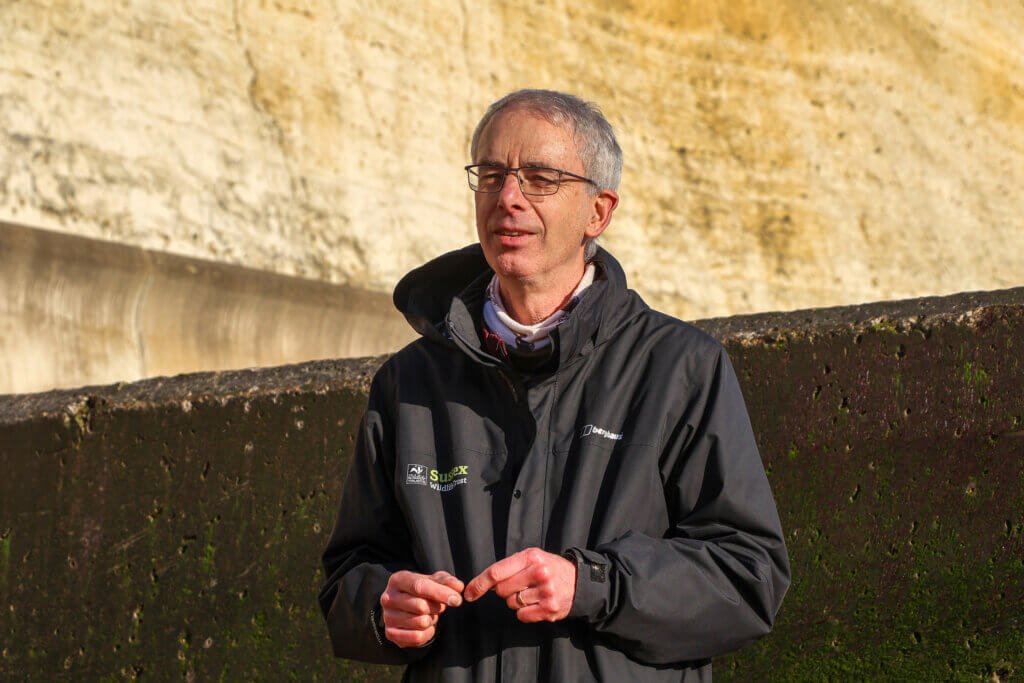

Chris Corrigan is CEO of the Sussex Wildlife Trust and has worked in nature conservation for almost 40 years. He spent most of his career with the RSPB, most recently as Director England, but has also worked for BirdWatch Ireland and Butterfly Conservation and is a trustee of the South Georgia Heritage Trust. He is a lifelong birder and naturalist.
It’s time to ditch Bio-beads
In mid-October, I was enjoying my annual pilgrimage to the lovely Isles of Scilly, oblivious to the existence of a bit of plastic called a bio-bead. How quickly things can change! Within the space of two weeks the East Sussex coastline was littered with millions of bio-beads and the aftermath has been the focus of my work ever since.
I now know a lot more about bio-beads and almost all of it bad.
What on earth is a bio-bead?

Bio-beads are tiny plastic pellets, about the size of peppercorns, which are used as part of wastewater treatment. The large surface area of millions of tiny beads makes an excellent home for beneficial bacteria which consume organic matter in wastewater prior to releasing it back into the sea.
Bio-beads should be made of inert plastic but in the many twists and turns of this tragic incident, all is not what it seems. More on this later.
What has gone wrong?
At the end of October, millions of black bio-beads were washing up on the beach at Camber Sands, close to the village of Rye. At first there was confusion and an assurance by Southern Water that these were not from the Eastbourne Wastewater Treatment Works which lies 25-30 miles along the coast to the west. However, after a delay of a week or so, it was revealed that about 10 tonnes of bio-beads had been released because the all-important retaining screen had split and failed. The exact circumstances of the incident are subject to an ongoing EA investigation and an independent investigation by Southern Water, the results of which will be made public. There are still many unanswered questions.

We had hoped that the bio-beads would not get into our nearby Rye Harbour nature reserve which is internationally important for a host of different species and habitats. With hindsight our optimism was misplaced and tragically the bio-beads entered through two sluices and fanned out across the saltmarsh and saline lagoons. As I write this, we are not sure of the best removal method and different options are being tested. Sadly, the only certainty is that we will never get rid of them all – we will just have to do the best we can.
It has not been easy. We have had to learn and respond to a changing situation simultaneously, working closely with a range of other organisations and stakeholders. This is a new experience for us and there seems to be little available information on what to do. I hope we can write up a case study when it is all over so anyone else in this situation can benefit from our learning and experience.
None of this was in our work plans but my team and everyone else involved have done a brilliant job in a very difficult and challenging situation.
The impacts

Millions of bio-beads are adding to the already overloaded burden of plastics in our marine and coastal environment and have affected the amenity value of the beaches enjoyed by so many people. However, from a wildlife perspective, the hazards of bio-beads are that they are indistinguishable from fish eggs or saltmarsh plant seeds. We can expect large numbers to be consumed by fish and wildfowl such as Teal and Wigeon. The impact of this is unknown and it is unlikely we will know the full impacts in the short term. If the effects are sub-lethal but reduce survival it may be many months or even years before we know the true impact. Indeed, we may never know at all given all the environmental factors at play, variable bird flu death rates in birds being a good example.
What has been done
This terrible pollution incident has created an inevitable fierce public backlash against Southern Water. We have also seen droves of volunteers offering to help clean the beaches alongside Rother District Council, Southern Water contractors, Strandliners and specialist clean up experts Nurdle with their giant vacuum cleaner.
Beaches are being cleaned as best they can be, including by volunteers on their hands and knees hand picking the tiny plastic pellets out of the sand. The saltmarsh is more complicated with the bio-beads clustered in patches among the dead Sea Purslane leaves on the strandline of creeks. We have managed to block the sluices and install a mesh net to stop, or at least greatly reduce, more bio-beads getting into the reserve.
The response by the public and other organisations and stakeholders has been amazing. One source of comfort has been watching so many people determined to help clean up the mess and make their views known. This is a sharp reminder of the passion of local communities for their local wildlife and environment. It is perhaps no surprise the two SWT blogs that have attracted the highest and second highest number of comments ever have been on bio-beads.
A sting in the tail
All along we have been assured that the bio-beads are made of inert plastic. However, an analysis of the chemical content of 200 bio-beads by Professor Andreas Baas of Kings College London revealed the unexpected presence of a raft of heavy metals including lead and arsenic. How this is possible is unclear given the assurances by Southern Water, whose own independent analysis of the beads has not been shared.
In the past, bio-beads were manufactured from old electrical equipment such as TVs and computers which could easily be the source of such contaminants. However, this should have stopped in 2003 when it was banned by the EU Directive on Waste Electrical and Electronic Equipment Directive (WEEE). Whether there are pre-2003 bio-beads in the release or some other reason remains a mystery as Southern Water have yet to make a comment.
The heavy metals are not at high enough levels to classify the beads as “contaminated waste” but heavy metals in the environment at whatever level is bad news. Prof. Baas has also highlighted the added ecotoxicity risk in the acidic gut of fish or birds which will trigger the release of the heavy metals. This only adds to the strength of the argument to end the use of bio-beads.
Let it never happen again! How you can help

We have teamed up with local MP for Hastings and Rye, Helena Dollimore who is leading a campaign to #BintheBeads and phase them out entirely as part of water company business planning processes. This is not just a Sussex issue, water companies elsewhere in England use bio-beads and ours is not the first pollution incident of its kind. Helena has the drive and commitment to make sure this is firmly on the government agenda. You can help too! Our blog explains how and the petition is found here. The deadline is 12th January so time is short.
What makes this campaign so powerful is that there is a solution. Bio-beads are old technology and modern membrane-based alternatives are available which would eliminate all risk of spills at a stroke. This will take time, but it can be done by including a requirement to switch as part of the next OFWAT regulated water company business planning cycle.
This will come at a price, but there is a price for not switching as we are seeing here in Sussex. As well as the clean-up costs there is also the reputational damage for Southern Water. More importantly, as ever the greatest price of all is paid by wildlife and the environment.
Please help – thank you!
[registration_form]
Source link