
I enjoyed much of this book, especially the writing, and I dare say it will be greatly appreciated by many, but I found that it was rather undermined by some structural issues and some choices that seem to have been made about its scope and reach.
It may be that this is an example of the two cultures and that I am too much embedded in science and logic fully to appreciate a book which says it is a ‘field guide to wonder and loss’. Or it may be that I am just a grumpy old man. You can decide but one of the essential points of a book review is to tell the potential buyer, and reader, about a book so that the reader of the review can decide whether or not to become a reader of the book. I can only tell you what I think having been a buyer and having read this book very carefully. So let me describe the book and then tell you why I like it but am not completely head over heels with it.
The book is 383 pages long with an almost equal number of pages of Jackie Morris’s illustrations and Robert Macfarlane’s words. There is a three and a half page Foreword which sets out that bird populations are often declining, and that this is the successor to a range of books, called field guides by the authors, but this is a field guide with a difference because although it may help you to identify birds, its real, and perhaps unique, point is that it will help you to identify with birds by using metaphor and story and poetry. An aim of this book, using word and paint is to evoke ‘each bird’s astonishing is-ness – what makes Sparrowhawk Sparrowhawk and what makes Bittern Bittern‘.
We are told that central to the book’s structure are the ‘Seven Wonders’ of Nest, Egg, Beak, Song, Feather, Flight and Migration. There are very short sections (about three pages each) on these subjects spaced through the book and in between are species accounts of 49 birds which are listed on the UK’s Red or Amber lists. There are some tables of facts and figures about the 49 species and three pages about bird names at the back of the book.
So far so good, but my misgivings with the book are mostly with what I can only call the structure of the book – the skeleton on which everything else hangs. These are matters that are partly the responsibility of the publisher and partly of the authors and they sometimes need some discussion and give and take to be resolved. I don’t know whether those discussions took place.
The title of this book is The Book of Birds, not The Hamish Hamilton Book of Birds (the imprint of Penguin which publishes this book in the UK at least) nor any other modest title but a rather all encompassing and otherwise excluding title, ‘The’. It’s not a modest title is it? And it’s a title difficult to justify based on 49 short accounts of an eclectic choice of UK species. Maybe A Book of Birds or Our Book of Birds, or maybe at a stretch The Book of UK Birds might have been a little more fitting.
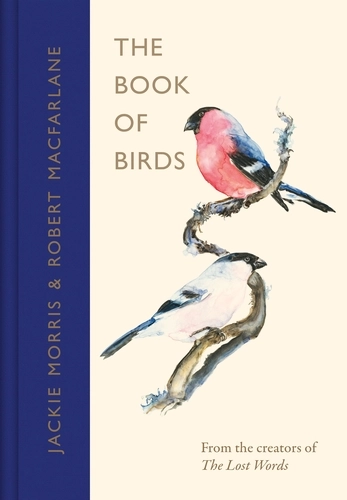
The publisher/authors collective doesn’t appear to know in which order the two authors should appear; on the cover and spine of the book it is Morris and Macfarlane but inside the book and on the publisher’s website it is t’other way around. Does it matter? Not much to me, and maybe only to a few librarians putting books on shelves in alphabetical order (and not very much to them since they have two surnames beginning with M), but it’s a bit like going out of the house with odd socks on; it doesn’t matter, but it might make people wonder whether you are making a statement or whether you are just a bit careless.
The subtitle, ‘a field guide to wonder and loss’ is missing from the book’s cover and spine, missing from the first title page at the front of the book, appears simply as ‘A Field Guide‘ on the second title page and is absent from the copyright page of information (which appears, unusually, at the back of the book) but is prominent on the publisher’s website. That’s all a bit odd.
In any case, the idea that this is a field guide is bending the concept quite a lot. It is claimed that this book was partly inspired by those classic field guides of yore which, it is said, include volumes such as The Reader’s Digest Book of Birds, The Observer’s Book of Birds, Audubon’s Birds of America and Thomas Bewick’s A History of British Birds. I don’t think these bird books have often been called field guides before as the idea of taking your unbound double elephant folio Birds of America into the field with you is challenging to imagine. A few lines later we are told that the difference between the current volume and those mentioned above, the classics of the field guide genre, is that this one uses paint instead of photographs. None of those books (and the others mentioned) are rich in photographs (I’ve checked my copies of The Reader’s Digest Book of Birds and The Observer’s Book of Birds) and it would have been particularly challenging for Audubon’s masterwork, published in the 1830s to have photographs and even more so for Bewick’s 1797 work. This characterisation of the book as a field guide, in a lineage of other field guides, is simply unnecessary and for those who know about the other books is distracting and doesn’t ring true. It is an unhelpful contrivance.
In books about birds there are two decisions that need to be made about the vernacular names of the species mentioned. They are; which name to use (Knot or Red Knot; Nightingale or Common Nightingale or Rufous Nightingale) and whether to capitalise the names (Kingfisher or kingfisher; Rook or rook). This book makes a bit of a meal of this in three pages near the end of the book and then doesn’t quite stick to what it appears to have decided. A sensible decision was to use the names that are familiar to the authors and many of the rest of us in the UK for these UK birds in this book. Thus, the Common Cuckoo is called the Cuckoo, the Eurasian Bittern is called the Bittern and the Eurasian Curlew is called the Curlew (even though elsewhere in the world there are other species of cuckoo, bittern and curlew). So far so good, but the dropping of ‘Common’ from many bird names seems to have left, by accident perhaps, the Common Tern, scientific name Sterna hirundo, named as Tern as one of the 49 species which looks and sounds bizarre.
I’m not sure why the 49 species chosen all came off the UK Red and Amber lists except to make a link with bird conservation and to justify the title of being a field guide to wonder and loss. This would have been just as good a book if the authors had chosen just a bunch of species, maybe including many of those included here, that they fancied illustrating and writing about. It’s not as though this book explains much about what the Red and Amber lists are or much about why species are declining. Where it does touch on the declines and their causes is in individual species texts and that is fine, and doesn’t require every species in the book to be declining or threatened.
I’m not sure the publisher and authors were clear in their own minds about where they wanted this book to sell – geographically. The species were chosen from those species that live in the UK but, of course, all of them live in other places too; many in Europe, some in North America, quite a few across the Atlantic and some other oceans, and many migrate to Africa in the northern winter. It felt to me a though there were more mentions of North America than one might expect in this book but I’d be surprised if those predispose an American audience to buy this book. It will be Macfarlane’s reputation as a writer, and the way he carries it off here, that will sell the book in the USA and Canada.
One of the slightly random-seeming references to North America comes in the second paragraph of the Foreword, so if you are somewhat conventional and flick through the book to look at the sort of thing that is coming up and then start at the beginning this is at the beginning of the second paragraph you read, and it is about a large flock of curlews (lower case), ‘four or five thousand birds‘, that was seen in Labrador in August 1861. Now, those curlews were not Curlews, Eurasian Curlews or Common Curlews because ‘our Curlew’ does not live in the USA. Nor were they the Long-billed Curlew which is an American species but lives mostly to the west of the Mississippi line, but they were, with almost no doubt at all, Eskimo Curlews which were phenomenally numerous and are now regarded as extinct since the last record generally regarded as genuine was in the early 1960s. The Eskimo Curlew was so numerous that further down the eastern seaboard of North America, a couple of years after the Labrador observation, on Nantucket Island, MA, a flock of Eskimo Curlews darkened the skies and the inhabitants of the island ran out of ammunition shooting maybe 7,000 of these birds out of this vast flock – of a now extinct bird! I don’t know whether the authors thought that the curlews in Labrador were ‘our’ curlews or whether they knew they were Eskimo Curlews but forgot to tell the story properly or whether some words were carelessly excised at some time. But this is a shaky start (second paragraph) for The Book of Birds.
Let me move on to Jackie Morris’s illustrations. These are an important part of the book and are given equal page space with the words including quite a few double page spreads. Jackie Morris’s paintings and drawings are often very attractive and you could happily spend time simply turning the pages to view the illustrations without reading a word. I like many of them, and as art they appeal, but as portraits of birds I know well, they are problematic because too few of them speak to me of the birds I love. Morris has a tendency to make birds, particularly in flight, look stretched – at least that’s how they look to me. Necks are too outstretched, heads are too small but beaks are very long. There are plumage details which aren’t quite clear or aren’t quite right too. This won’t matter if you’ve never seen these birds before, it won’t matter at all, because they are still attractive, but for those who know them well and love them, these illustrations do not, for me at least, always capture those familiar birds.
And so to the text. This is a different book from any other bird book I know and it will bring a fresh perspective that may gel with many people, some of whom will not have been attracted to birds so far. Each of the 49 species gets around four or five paragraphs the first of which is often a bravura coloratura piece of writing by Macfarlane that is often prose poetry. There is very clever use of words in many places and that is actually what makes the book so different and what makes it good. I particularly liked the texts for Capercaillie, House Martin and Sparrow (which should have been called House Sparrow). I nodded or smiled many times and that made the reading quite easy. These are fine examples of writing and if you read them out loud (or at least read them with the sounds echoing in your head) then many are very clever. They may take you to the essence of the species described and the following paragraphs often do a more workaday job of describing something about the status or ecology of the bird and often there are accounts of old names for the species or its place in folklore.
Macfarlane’s approach works very well for individual species because they each have a ‘character’ that can be celebrated but I felt that the ‘Seven Wonders’ of Nest, Egg, Beak, Song, Feather, Flight and Migration worked less well, maybe because these are more biological subjects. Also, there are many types of egg, migration, nest etc whereas each individual species has its own persona, or imagined persona.
This is a good book but it isn’t nearly as good as it might have been – that’s my opinion. The writing of Macfarlane and the illustrations of Morris make a different and very welcome addition to books about UK birds. My plan for this book would have looked a bit more like The Reader’s Digest Book of Birds with fine illustrations and text for lots more species.
The cover? Well, it doesn’t look as washed out on my copy of the book as it does in this image taken from the publisher’s website. I’d give it 8/10 because it is attractive and uncluttered.
The Book of Birds: a field guide to wonder and loss by Robert Macfarlane and Jackie Morris is published by Penguin.
You could buy this book from Bookshop.org and I have set up a booklist to make that easy through this link https://uk.bookshop.org/shop/MarkAvery Disclosure: I am an affiliate of Bookshop.org and I will earn a commission if you click through and make a purchase
[registration_form]
Source link