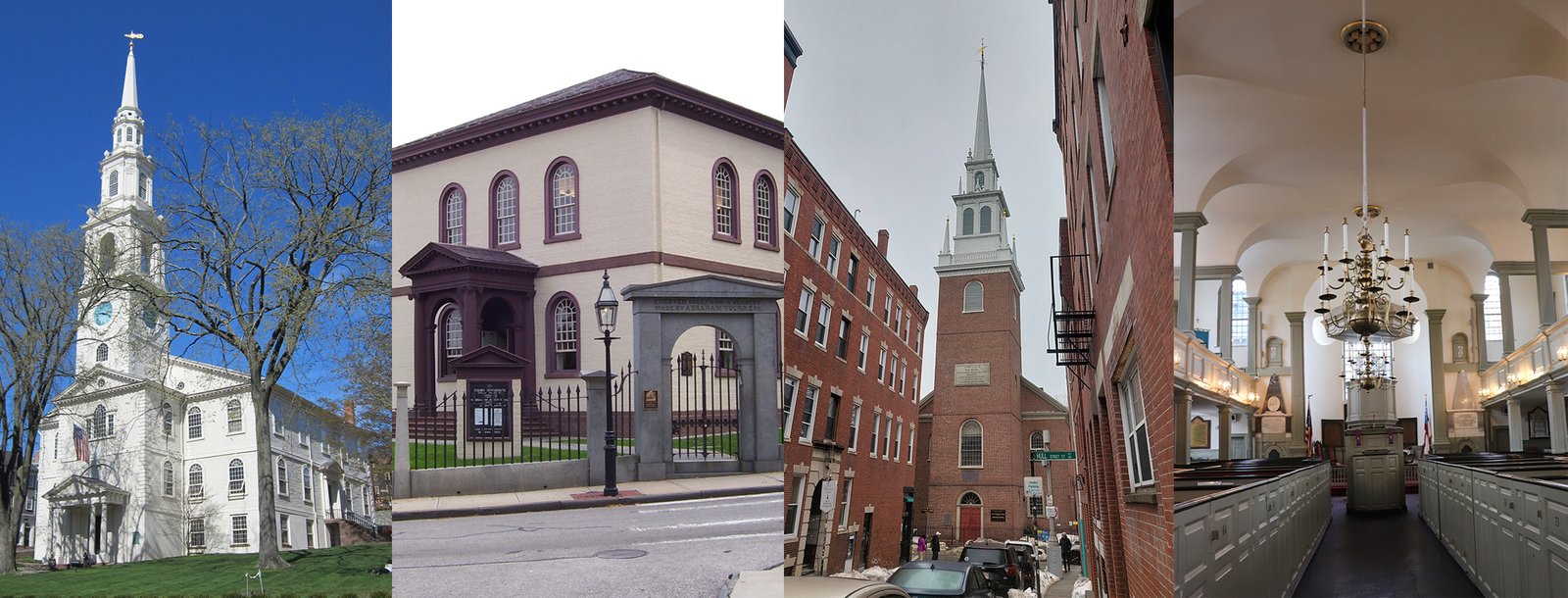
(RNS) — On Ash Wednesday this year, about a dozen people attended a noon service at Boston’s Old North Church, founded in 1723. Two days later, a handful of worshippers took part in a Shabbat service at Newport, Rhode Island’s Touro Synagogue, dedicated in 1763. Congregations participating in sacred rituals — it is something both houses of worship have been doing longer than the United States has existed.
Such places of worship are rare. The Hartford Institute for Religion Research estimates that of the 370,000 religious congregations in the U.S. today, only about 1% existed at the country’s founding.
When the country declared independence in 1776, there were 3,228 houses of worship across the Colonies. The U.S. was already religiously diverse. Congregationalists led the pack with about 670 congregations, or just over 20% of the total. Presbyterians weren’t far behind (18%), followed by Baptists and Episcopalians (each about 15%), and Quakers at nearly 10%. Methodists had a following at 2%, Catholics were just under 2%, and there were a handful of synagogues and more than a dozen Mennonite congregations, according to sociologists Rodney Stark and Roger Finke.
Most of them dissolved due to internal conflicts, financial strains, aging membership and/or the impact of war. Many of the places that survived, like Old North Church and Touro, did so by continuing to gather, whether in ornate or simple buildings, or when pews were full or had just a few worshippers.
RELATED: From New York to Alabama, blacks worshipped in own spaces before slavery’s end
“I think that’s how faith, church and faith, is perpetuated — it’s not, in a way, by big, splashy events,” said the Rev. Matthew P. Cadwell, vicar of Old North Church. “It’s by people who really want to take the time to reflect on what it means to be human and what it means to be a person of God in a complicated world.”
Below are portraits of four that have endured.

Congregants receive Communion during an Ash Wednesday service on Feb. 18, 2026, at Old North Church in Boston. (RNS photo/Adelle M. Banks)
Old North Church, Boston
Founded: 1723
Affiliation: Episcopal Church
Famous for: Lanterns in steeple marked start of Revolutionary War
BOSTON — Cadwell welcomed just about a dozen people to this year’s noon Ash Wednesday service. Knowing there could be some tourists in the pews, Cadwell, the church’s leader since 2020, was careful to offer guidance after the first hymn for those unfamiliar with the standing, sitting and kneeling practices of the Episcopal Church.
“There are kneelers in the pews — they’re exceptionally uncomfortable, and so you will feel penitent, for sure, if you use them,” he said. “I’ll be kneeling in the front on behalf of all of us, if that works, but kneeling yourselves, if you like, or stand — whichever, works for you.”
Old North started as something of an outlier — a Church of England congregation in a city dominated by Puritan-rooted Congregationalists. Today it offers a spiritual space to Boston-area residents and tourists from around the world, including people from the country that once opposed colonists in the Revolutionary War.
“We’re honoring our neighbors,” Cadwell said.
Jenifer Miller, a native of Rochester, England, joined Old North Church a couple of years ago. Stepping into the box pews that date to 1723, Miller said she thinks of those who worshipped in the same place centuries ago.
“You imagine all the people that have sat there before and all that, and we all have the worries, we all have the wants, we all have the loves and the sadness all through life,” she said. “So I enjoyed the thought that this is not new. It’s been around for a long time.”
The church’s revolutionary history is undoubtedly a draw for tourists as well as locals. It was from Old North’s steeple that two lanterns were hung in 1775, signaling that British forces were advancing by sea — the moment Henry Wadsworth Longfellow immortalized as “one if by land, two if by sea.”

Musicians perform during an Ash Wednesday service on Feb. 18, 2026, at Old North Church in Boston. (RNS photo/Adelle M. Banks)
Cadwell, who has a Ph.D. in Anglican history and theology, said the church’s understanding of that night has evolved: It’s now believed that sexton Robert Newman was joined by Capt. John Pulling Jr., a vestry member and friend of Paul Revere, to climb the stairs and ladders and hang the lights from what was then the tallest structure in the city.
After the service, Carol Ball, a vestry member in charge of ensuring Old North’s brass chandeliers are kept shining, said the church embraces all visitors, whether they come for a tour or choose to become members.
“It’s usually 50-50, I’d say, between congregation and tourists,” she said. “It’s a very nice mix.”

First Baptist Church in America on Feb. 19, 2026, in Providence, R.I. (RNS photos/Adelle M. Banks)
First Baptist Church in America, Providence, Rhode Island
Founded: 1638
Famous for: Nation’s oldest Baptist congregation
Denomination: American Baptist Churches USA
PROVIDENCE, R.I. — “Whether you’re sober or you wish you were, whether you’re straight or gay or cis or trans, or whether you are a citizen of this nation or not, in this place, you are a citizen in the realm of God.” That is how the Rev. Jamie Washam begins the Communion service at First Baptist Church in America.
Her words, she explains, are intentional: “We all have the same beeline to the divine.”
The sentiment is baked into the DNA of the church. Roger Williams, a Puritan pastor in Salem, Massachusetts, was excommunicated for his views on church-state separation and then gathered a group of worshippers to start a new church in Providence. At a time when Massachusetts had a state religion, the Congregational Church, Williams concluded that “the only proper form of baptism was believer’s baptism, and so he baptized his congregation, about 20 people all together,” said J. Stanley Lemons, author of “First: The First Baptist Church in America.” (Due to Williams’ influence, Rhode Island never decreed a state religion.)
Williams left the Rhode Island church after a few months (though he continued to preach). But it endured, surviving internal divisions and opening its “meetinghouse” doors regularly, including for historic gatherings.
Standing just a half mile away from the Rhode Island State House, First Baptist occupies a tall, steepled building with columns and box pews in its square interior, influenced by English Georgian architecture and erected in the 1770s. At the time, it was also the only church in New England with a steeple or a bell.
“This was the first building like this for Baptists anywhere,” said Lemons during a February interview at First Baptist. “Baptist meetinghouses prior to this one were quite plain — places the Quakers would have been quite happy to be in. But this one is much more ornate, designed to impress.”
In its early years, congregational singing was forbidden because churches affiliated with the General Six Principle Baptists, as First Baptist was at the time, “believe that everything should be spontaneous and from the Spirit,” said Lemons. Elder John Manning, a new pastor in 1771, introduced singing in an afternoon service and the practice was retained after “a series of meetings where people came in from the countryside to vote.”
The building was the site of the Triennial Convention in 1845, where the North-South divide over slavery led to a formal split among U.S. Baptists. The Northerners decided that foreign missionaries should not be commissioned if they owned slaves. A week later, the Southern Baptist Convention was founded in Augusta, Georgia.

Crowds attend a Brown University commencement at First Baptist Church in America in 1914, in Providence, R.I. (Photo courtesy of J. Stanley Lemons/First Baptist Church in America)
First Baptist remains affiliated with the American Baptist Churches USA, formerly known as the Northern Baptist Convention.
Today, the congregation is predominantly white and includes longtime Baptists, native Rhode Islanders and others from a variety of geographic, ethnic and theological backgrounds, said Washam.
“We regularly have people visiting us from all over because they’re Baptists and they want to come to this place,” she said. “And we know if they’re singing the third verse without looking at the hymnal, they’re probably a pastor.”
Its community outreach ranges from offering “blessing bags” with peanut butter crackers, bottles of water and socks for individuals in need to hosting baccalaureate services for students of nearby Brown University, continuing a tradition that began when the edifice held a commencement ceremony shortly after its 1775 dedication.
Washam, pastor of the church since 2015, said its missions committee hosts dinners at local restaurants whose fare ranges from South Asian to South American in a show of support for the immigrants and refugees who run them.
“We cannot swiftly change domestic policy, necessarily, or international policy, but we can, with our dollars and our bodies and our taste buds, show up and meet our neighbors and say we are better because you’re here,” she said.

Interior of Touro Synagogue in Newport, R.I., in an undated photo. (Photo courtesy of National Park Service/Public Domain)
Touro Synagogue, Newport, Rhode Island
Founded: 1763
Affiliation: Orthodox Judaism
Famous for: Correspondence with George Washington
NEWPORT, R.I. — Touro Synagogue, dedicated in 1763, is the oldest standing synagogue in the U.S. Located one-tenth of a mile from the Old Colony House, a seat of government when Rhode Island was a colony, the synagogue was built by a Jewish community that included Sephardic Jews, people of Spanish and Portuguese descent fleeing religious persecution in Europe.

The 1790 correspondence between Touro Synagogue and George Washington. (Image courtesy of Mount Vernon)
“The synagogue might have seemed to be a miracle to the people that created it — I think it’s still a miracle,” said congregant Aaron Ginsburg as he concluded a tour of the Orthodox synagogue in February.
On a Friday evening in February, four men on the main level and two women in the balcony gathered for prayer, reading in Aramaic as the light faded through the clear windows. “He creates day and night. He rolls the light away from before darkness, and darkness from before light,” according to a translation. Orthodox services require a minyan, 10 men who have been bar mitzvahed, in order to say certain prayers. Because there were fewer, the Friday service was shortened.
“It can be difficult, but we make do pretty well,” said James Herstoff, who is secretary-treasurer of the congregation that meets at the synagogue. “And even now in the wintertime, we still have tourists coming in, which help make minyan on Friday night and Saturday both. So, services continue on regardless.”
In 1790, the year after George Washington became the first U.S. president, Moses Seixas, then the synagogue’s leader, presented Washington with a letter praising “a government, which gives to bigotry no sanction, to persecution no assistance.” Washington later became known for those same words though he was echoing the letter’s words back in a written response to the synagogue.
The synagogue has faced many tests.
Touro was mostly closed for decades after the Revolutionary War as most Jews left Newport, which was economically and physically devastated. Congregation Shearith Israel, a New York Sephardic congregation that owns the Touro Synagogue building, preserved some of the artifacts until Ashkenazi Jews, who were from Eastern Europe, arrived in the area in the late 19th century, leading to the reopening of the synagogue.
In 2012, Congregation Jeshuat Israel, then the building’s lessee, and Congregation Shearith Israel began arguing over antique silver bells cast by a Jewish contemporary of Paul Revere, confirmed Herstoff, who is a leader of the new lessee, Congregation Ahavath Israel. Litigation made its way through the courts, eventually resulting in a 2025 Rhode Island Supreme Court decision evicting Congregation Jeshuat Israel. The new congregation leased the Touro Synagogue building from its New York-based owner and has kept services running there.

Touro Synagogue in Newport, R.I. (Photo by Kenneth C. Zirkel/Wikimedia/Creative Commons)
“Congregation Ahavath Israel was formed to be ready to come in should the eviction take place, so that services could continue totally uninterrupted at the synagogue, and that is what happened,” said Herstoff.
While giving a tour, Ginsburg pointed out the charity boxes donated in 1769 and noted they are still in use. He did not mention the dispute. “The miracle is not the building. The miracle is that we still worship here, 263 years after our predecessors started to do so, praying to the one above that all will be well with us and we will do good things, both for ourselves and the human community,” he said.

Trinity Church in Newport, R.I. (RNS photo/Adelle M. Banks)
Trinity Church, Newport, Rhode Island
Founded: 1698
Affiliation: Episcopal Church
Famous for: Three-tiered wineglass pulpit
NEWPORT, R.I. — Trinity Church is the only church in the country with a three-tiered wineglass pulpit still standing in the center aisle. Boston’s Old North and other churches have shifted theirs to give clearer sight of the Communion service on the altar, said historian John Hattendorf.
Trinity’s isn’t moving.
“It is the best place to see everybody in the church and, if there’s people in the balcony, it’s really the best place to kind of be with people on both levels,” said the Rev. Meaghan Kelly Brower, who was appointed rector in August.
The Episcopal congregation dates to around 1698, though its current building was completed in 1726.
Brower, who grew up in the congregation, recalls watching priests ascend the stairs as a child. She said the high pulpit creates an unusual intimacy between preached word and the people. “I honestly think part of my own call to priesthood was actually a call to preach, because I watched people climb up into that pulpit,” she said.
George Washington, Queen Elizabeth II and other dignitaries have visited the historic building with its white wood exterior and tall steeple — described on the church website as “a beacon on the Newport horizon.” But the wooden pews are remnants of a harsher period, when church members were required to purchase pews and enslaved people of color, including Native Americans, were sent to the narrow pews in the balcony, according to Hattendorf, author of “Semper Eadem: A History of Trinity Church in Newport 1698-2000.”
That changed in the 19th century but a special box pew — No. 81 — remained reserved for visitors considered VIPs. “When I first came to the church in the 1960s, the first person in uniform would be seated there,” said Hattendorf. “So I sat there a number of times when I was wearing my young naval uniform.”
Brower said she’s preparing for the big moments of the church’s tricentennial celebration — including “Trinity Sunday” on May 31 that is set to feature Episcopal Presiding Bishop Sean Rowe.
Though pews are no longer bought, Brower said it can be difficult for the predominantly white and middle-class congregation to shake off its long-held reputation “that you have to be a certain kind of person to come to church here.”
“Every single person is welcome here and we are all just humans trying to survive the world today,” she added. “There’s no criteria for membership other than a desire to connect with God and one another.”
Brower hopes Trinity Church’s central location steps away from souvenir shops and restaurants can be a draw for community members as well as tourists, some of whom visit during a cruise ship stop.
She said the congregation has been working to make the church more welcoming. It provides a community meal a couple of Mondays a month, offers its lawn to a music education program for families with young children in the spring, and raises funds for local nonprofits through a community pumpkin patch on its land in the fall.
Recalling how her early involvement in the church influenced her, Brower makes sure that Sunday school students have the opportunity to “be nice and close” around the Communion table to witness her leading that part of the service.
“There were years where the noise of children was not a welcome addition to a church service, and I think now it’s a really beautiful sign of life,” said Brower. “It’s that blend that I hope we’re bringing to the table now, of honoring that tradition and finding comfort in the ritual without feeling like we have to be rigid in our alignment with it.”
RELATED: Faith groups seek out founding documents in bid to rescue democracy
Source link