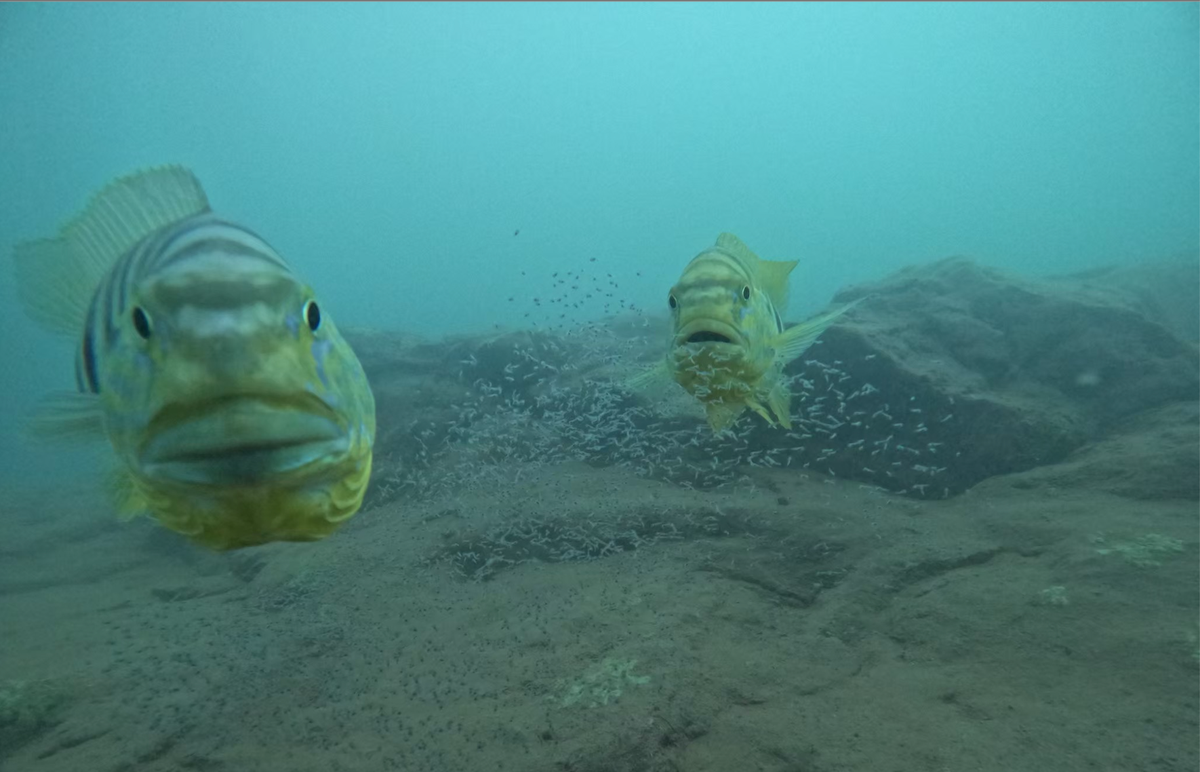

These fish can tell when you’re staring
Fish may possess the ability to perceive where another being’s attention is focused. And they don’t like when it’s focused on them or on their children
Male (left) and female (right) emperor cichilds behaving aggressively toward a diver by flaring their gill covers.
Satoh, et al. Royal Society Open Science (CC BY 4.0)
Do you know that uncomfortable feeling of being watched? A new study shows that fish also seem to know when they—or their kids—are being stared at, and that they don’t like it. The work, published Tuesday in Royal Society Open Science, gives rare insight into the minds of fish.
Previous research has suggested that some primates, domestic animals and birds seem to possess what is called attention attribution—the ability to perceive where another individual is focused. “It means distinguishing not just who is present but what that individual is paying attention to,” says study author Shun Satoh, a fish biologist at Kyoto University in Japan.
To see whether fish might possess this ability, the team went to Lake Tanganyika in eastern Africa to conduct different experiments on the emperor cichlid (Boulengerochromis microlepis), a species that is neither too fearful of nor too aggressive toward humans. Using waterproof cameras, the team recorded how adult fish guarding their offspring behaved when a diver looked at a fish’s eggs or its recently hatched youngsters, looked in another direction, or looked at the fish itself. The researchers also observed what happened when the diver turned 180 degrees from the nest.
On supporting science journalism
If you’re enjoying this article, consider supporting our award-winning journalism by subscribing. By purchasing a subscription you are helping to ensure the future of impactful stories about the discoveries and ideas shaping our world today.
An analysis of the recordings showed that the parents behaved aggressively toward the divers more often when the human interlopers were staring at the offspring or the parent, compared with when the diver was looking in another direction or completely turned away.
Though the authors acknowledge the study is preliminary, the results suggest that “the fish do not respond only to a diver’s presence but also to cues related to where the diver’s attention is directed,” Satoh says.
The study is a great starting point to answering whether fish possess attention attribution, says Gabrielle Davidson, a behavioral ecologist at the University of East Anglia in England, who was not involved in the work. “Animals are so sensitive to eyelike stimuli that we would expect them to find the gaze threatening or scary if it was directed at them,” she says. The study seems to go a step further, however, by showing that the fish might be able to track where the diver is looking at. “It’s not just a reflexive response to eyes being straight at them.”
Davidson thinks this ability could be widespread in other fish species, but she adds that more research is needed to figure out if the fish are actually looking at the diver’s gaze or if they are responding to other cues.
“One of the biggest challenges is to know what’s inside the mind of other animals,” she says. “These types of extra conditions and experiments can take us a step forward to revealing the inner understanding of these animals.”
It’s Time to Stand Up for Science
If you enjoyed this article, I’d like to ask for your support. Scientific American has served as an advocate for science and industry for 180 years, and right now may be the most critical moment in that two-century history.
I’ve been a Scientific American subscriber since I was 12 years old, and it helped shape the way I look at the world. SciAm always educates and delights me, and inspires a sense of awe for our vast, beautiful universe. I hope it does that for you, too.
If you subscribe to Scientific American, you help ensure that our coverage is centered on meaningful research and discovery; that we have the resources to report on the decisions that threaten labs across the U.S.; and that we support both budding and working scientists at a time when the value of science itself too often goes unrecognized.
In return, you get essential news, captivating podcasts, brilliant infographics, can’t-miss newsletters, must-watch videos, challenging games, and the science world’s best writing and reporting. You can even gift someone a subscription.
There has never been a more important time for us to stand up and show why science matters. I hope you’ll support us in that mission.
Source link