Vulnerable aquatic plant found in Hampshire

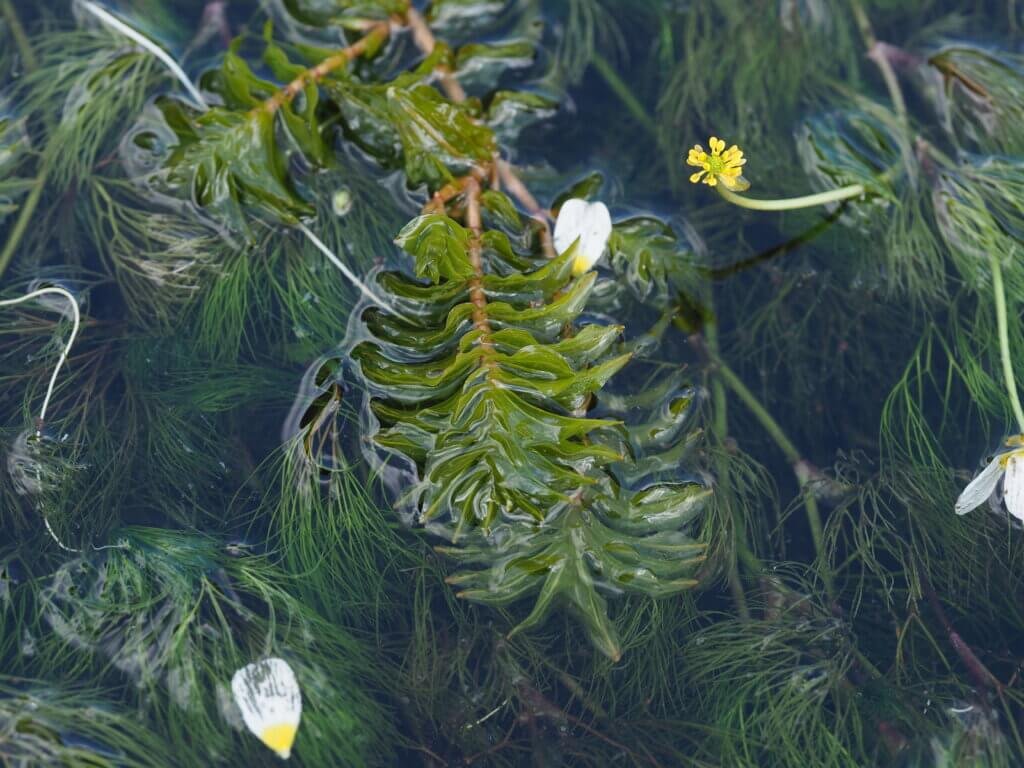
Opposite-leaved Pondweed has been discovered at a site in the lower reaches of the River Ems in Hampshire. This is the first record for the Ems catchment area since 1887: the year of Queen Victoria’s Golden Jubilee.
Tristan Norton, a local Government ecologist who is also the Botanical Society of Britain and Ireland’s County Recorder for South Hampshire, was on a site visit late last year to discuss possible restoration plans for the Ems and associated floodplain habitats. These plans are being led by the Western Sussex Rivers Trust (WSRT), part of the UK-wide Rivers Trust, a non-governmental organisation aiming to protect and enhance the UK’s rivers through collaboration between river and wetland experts, landowners and community groups.
Tristan said “I explored the various in-channel and riparian modifications on the River Ems, north-east of Emsworth, and its various carrier streams. The only sizable patch of large aquatic plants was a few metres of Stream Water-crowfoot in a narrow channel within an extensive private garden. The channel bed was clean gravel, unshaded, and the flow was clearly sufficient to allow chalk stream vegetation to persist. In one corner of the garden, there was a large pond, connected to the main river channel and sitting close to a series of springs. Someone had clearly dug the pond to create an attractive water feature in the garden and it seemed a pleasant spot to sit on a warm day, glass in hand.

I walked around the pond to see what was growing in the water, and spotted lots of Common Water-plantain, some duckweeds and water-starworts. I was just saying to the WSRT ecologist how lovely it would be to see plants such as Opposite-leaved Pondweed once again flourishing in a rejuvenated Ems. Then, to my great delight, I saw it! The green centipede shape of Opposite-leaved Pondweed was lurking just below the water’s surface and was instantly recognisable. I was so excited that I let out a cry and called everyone over to look. On closer inspection, I could see that the plant actually covered around a third of the total pond area”.
BSBI Head of Science Kevin Walker said “Opposite-leaved Pondweed has declined in Britain owing to factors such as urbanisation, which has led to its loss from the London area; the drying-up of spring-fed streams and ditches because of falling water tables; eutrophication; and the lack of ditch management, which is necessary to prevent the open water communities becoming overgrown by emergent species. The plant is now classified as Vulnerable on the England Red List. This decline began before 1930, but is still continuing. Opposite-leaved Pondweed was refound at just 23% of a sample of post-1970 sites revisited between 2008 and 2013”.
Tristan said “This find constitutes the first record of Opposite-leaved Pondweed for the Ems catchment since at least 1887, when Queen Victoria was on the throne. It seems inconceivable to me that the owners would have purchased such an obscure plant for their pond, so I presume that this is a surviving fully natural population. It raises hope that this fast-declining species may be persisting in out-of-the-way locations such as garden ponds”.
ENDS
[registration_form]
Source link