
Introduction:
This blog was prompted by reading the Draft Management Plan for the Forest of Bowland National Landscape (the new name for the Forest of Bowland Area of Outstanding Natural Beauty). I have written several earlier versions of this blog and electronically ripped them up and put them in the bin. This is where I have arrived. It’s a long blog in six parts:
- Introduction – you’ve just read that.
- The Forest of Bowland
- Hen Harriers in Bowland
- The plight of Hen Harriers – Epstein or Post Office?
- The Forest of Bowland National Landscape Draft Management Plan
- My response to the consultation on the Forest of Bowland National Landscape Draft Management Plan (and a request that readers of this blog respond in a somewhat similar way to me, but that is entirely up to you).
The Forest of Bowland
The Forest of Bowland isn’t a forest, or at least it’s one of those medieval royal hunting forests that don’t necessarily have many trees (click here). It’s an area of rough farmland and upland moors northwest of Clitheroe and northeast of Preston. On a clear day, you get great views of Morecambe Bay and the Lake District from the Jubilee Tower Car Park.
The land use is grazing animals, shooting Red Grouse for fun and a sizeable area is managed as a water catchment by United Utilities. People visit the area to hike, ramble and look at the view from their cars.
Areas of Outstanding Natural Beauty in England and Wales (Scotland is similar but different) were created under the same legislation as National Parks (The National Parks and Access to the Countryside Act of 1949). There are AONBs in Northern Ireland too. The Forest of Bowland AONB was the 13th established (1964) and is the 10th largest (803km²).
AONBs are like small, less well known, and quite honestly, less impressively beautiful, National Parks and do not have the same planning powers as National Parks as the AONB is not a planning authority. They are both going to be called National Landscapes but National Parks are loathe to change their names as they are well known and AONBs are happier to change their names because it doesn’t make much difference.
AONB and National Park are landscape designations but pretty landscapes are often rich in wildlife.
The logo of the Forest of Bowland AONB is the Hen Harrier. I read that the Forest (or Trough) of Bowland used to have a Goshawk as its symbol but when the AONB was established this morphed into a Hen Harrier because that was a well-known bird of the area which hunts for voles and small birds over the rough grassland and heather moorland.
Hen Harriers in Bowland
Yes, the Hen Harrier is the logo of the Forest of Bowland AONB and that is because the Forest of Bowland was once the best place in Britain for this bird with high densities and good nesting success. The numbers of Hen Harriers led to the Bowland Fells being designated as a Special Protection Area (SPA) for birds under the EU Birds Directive (but it was the UK government that chose Bowland as such a site not some Brussells bureaucrat). The Bowland Fells SPA was designated in 1993 and covers an area of 160km² (that’s less than the AONB because we find more of the area pretty than Hen Harriers find suitable for nesting) and the qualifying number of eight pairs was I believe exceeded with around 14 pairs. The numbers of Merlins and Lesser Black-backed Gulls were also reasons for designation.
The numbers of Hen Harriers nesting in Bowland each year are not brilliantly documented nor are they agreed even between the raptor workers who have worked there over the years but it is clear that there were Hen Harriers nesting in Bowland in the high 30s of pairs in the 1980s and numbers have been much lower since with a poor record of successful nesting on grouse moors over many decades despite grouse moors covering more than half of the SPA area.
Further reading on numbers of pairs (see Bowland’s Lack of Raptors by Terry Pickford, click here (and read the comments as well as the blog post itself); Some quotes from Terry Pickford again about raptors in Bowland pointing out there were 39 nesting Hen Harrier females in 1974 – click here; Tim Melling recollecting 30 pairs of Hen Harrier in Bowland (probably in the late 1970s/early 80s – click here; Poor Old Duke pointing out that one very rich Duke’s grouse moor occupies almost half of the Hen Harrier-suitable habitat in the SPA and yet rarely has any nesting Hen Harriers (see comment by Paul Irving) – click here; and Hen Harrier Sensitive Zones with comments from Chris Corrigan, Paul Irving and Terry Pickford – click here.
Nesting numbers and nesting success aren’t the only measures we have – we have sudden disappearances of birds which indicate persecution of nesting birds by humans (at a guess, gamekeepers). Male Hen Harriers do most of the provisioning of chicks in the nest (where the female stays too, to guard the chicks) which means they fly away from the nest to hunt for voles and small birds (which include Red Grouse chicks) which they bring back to the nest. These hunting sorties can be of several kilometres which means that even if the nest location is monitored and protected, the males may fly over dangerous territory where they may come to harm. Killing provisioning males is thought to be a favoured form of persecution because the males revisit good hunting grounds and removal of the male often leads to complete nest failure. Last year, 2025 – click here – two males disappeared in this manner from protected nests in Bowland, in 2015 – click here – three males disappeared in this way.
Where birds are satellite tagged then sudden disappearances of birds whose tags have been behaving normally are taken to indicate killing of the bird and destruction of its tag. A bird that dies naturally transmits a signal for many more days but doesn’t move – quite different from a tag that simply ceases transmission.
Here’s a map of one small part of Bowland, on the edge of the SPA, where five satellite-tagged birds disappeared over a period of years to illustrate the problem.
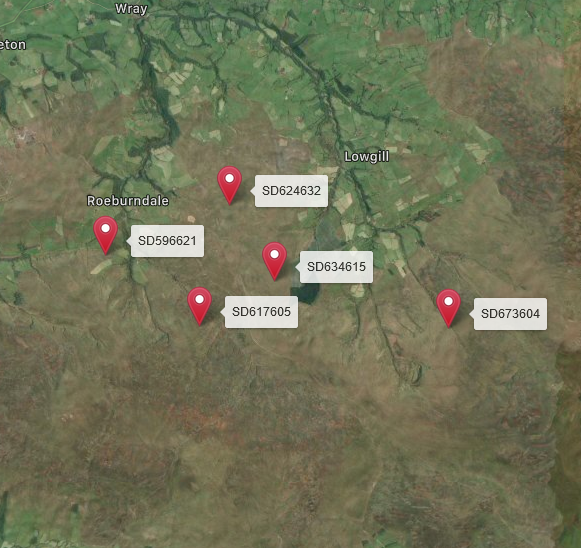
This was clearly one of many very dangerous places for Hen Harriers to go in Bowland.
Lest you imagine that it’s only Hen Harriers that get such rough treatment from persons unknown (but believed by many to be gamekeepers) then just take a look at this video footage of a visit to a Peregrine nest in the Bowland Fells SPA in 2016…
… and read the excellent RPUK blog from that time – click here.
And those Lesser Black-backed Gulls which made up one of the largest colonies in the European Union – the Abbeystead estate staff were bumping them off illegally and it took a run of 23 blogs here to push that issue to a conclusion and a public one too – click here.
Enough, I hope. And I hope that there is enough here to persuade those new to this subject that in the beautiful Bowland Fells dark deeds have been done to protected wildlife such as Hen Harriers, Peregrine Falcons and Lesser Black-backed Gulls and that some of these dark deeds have occurred on grouse moors. Those same grouse moors seem to be very unlucky in attracting nesting Hen Harriers despite the fact that a few decades ago they held lots of Hen Harriers and despite the fact that the grouse moors occupy over half the total area of the Bowland Fells SPA.
There are many of us who believe that gamekeepers from grouse moors are the reason why so few Hen Harriers nest in Bowland these days and so few nest across the English uplands compared with how much apparently suitable habitat there is. There can’t be much doubt about that generality since governments have directed schemes at those very grouse moors to try to get a better outcome but have failed.
There is a conflict between being able to shoot lots of Red Grouse for fun and having lots of attractive birds of prey flying around – the birds of prey eat some of the Red Grouse that rich people want to shoot. Hen Harriers and Peregrines are completely protected by law and you can’t bump them off to get a better day’s grouse shooting. If you do, you’re breaking the law.
The plight of Hen Harriers – Epstein or Post Office?
The thing about the Epstein scandal, that is said over and over again, is that it is rich and powerful people (usually men) getting away with things because of their contacts and networks and their money and power. I nominate illegal raptor persecution across great swathes of the uplands as a very similar case. There is hardly a poor person owning a grouse moor – these are the playgrounds (actually the killing fields) of Dukes, Earls and the nouveau riche. The summer parliamentary recess is said to be partly set to allow a good few days grouse shooting at the beginning of the season, and both Boris Johnson and David Cameron have had days’ ‘sport’ and Nigel Farage is a keen grouse shooter.
The grouse moor owners have tenants and staff who depend on them for their homes and who can’t upset their bosses or landlords but they also have upwards power. I remember many years ago being told by a grouse shooter that if ‘we’ (I think he meant the shooting fraternity but it might have been an even broader ‘we’), if we have any problems with government we just get Gerald (the late Duke of Westminster, father of the current Duke of Westminster (that’s how it works!)) to phone the Prime Minister and that usually sorts things out. There may have been some bravado in that, but that is how influence works still in Britain today. I once met the late Duke of Westminster, with the RSPB Chief Executive, at Abbeystead because we were invited up there for a chat, and I remember his nicotine-stained fingers moving quite nervously but also that he didn’t seem as keen on Hen Harriers as we were.
The stately homes of upland England are full of influential people either as owners or as guests being entertained, and influenced. Parliament, the judiciary and the police, as a whole, have been less than helpful in tackling wildlife crime which is carried out on a wide scale. Why isn’t it tackled?
The Forest of Bowland National Landscape Draft Management Plan
The Forest of Bowland National Landscape has produced a Draft Management Plan for its area which will take us up to 2031. Does it speak truth unto power? Does it make wildlife crime a big issue? No, it doesn’t.
The Draft Management Plan is not a plan for action because it doesn’t identify how much action is needed, of what kind, by whom and by when. It is a rather sorry thing. If you don’t set out the simple details of what, how much, by whom by when and provide the resources to do those things, you don’t have much of a plan.
However, there is one tiny piece of this Draft Plan that caught my eye and gave me some hope. On page 55, in the words about desired outcomes for important species, there are these words; 6F Establish a local management approach to combat and eradicate illegal persecution of hen harriers (and other raptors). Now, I have no idea what ‘establish a local management approach’ really means, it isn’t clear at all, and it could be good or bad, but “to…eradicate illegal persecution of Hen Harriers” is something that needs to happen in this little area of upland England, and many others, so I want to support that ambition. I’ve focussed on that area of the Draft Management Plan in my response to the consultation.
The consultation – click here – closes on 2 March which gives you this weekend, all next week and next weekend to make a contribution. It’s very easy to comment, it just takes some time to wade through the plan and to get it straight in your head. I hope I have done some of that for you and what follows is my response.
My response to the consultation on the Forest of Bowland National Landscape Draft Management Plan
1. Are you responding personally, or on behalf of an organisation? Personally
2. Which of the following best describes your point of view? Visitor to the area (live outside the National Landscape)
3. To what extent do you agree or disagree with the proposed vision for Forest of Bowland National Landscape? (see p.29 of the plan)? Agree
4. Additional comments on the vision: I agree with the general drift of the Vision but the Vision is for 2040 and is very vague. The outcomes towards that vision that will be delivered by this plan are largely unspecified. Therefore, I don’t think you really know where you are going or how far you intend to have travelled in the next five years. You have already broken your Core Principle 2 which is to focus on outcomes – your focus is far too fuzzy to guide action. The 2040 outcomes, and the progress that will be made under this Management Plan need to be much more tightly specified.
5. This Management Plan is built on a set of core principles which provide a framework to guide policy and practice in Bowland. Accepting these principles is essential to adopting and delivering the plan. Do you think we have identified all the relevant principles? (see p.29 of the plan). No
6. If you answered “No”, please list any principles you think are missing, or provide suggestions for improving or clarifying the principles? Compliance with the law of the land should be a key principle, and any organisation not agreeing to that should be excluded from further influence on this plan. Clearly the status of the Hen Harrier in Bowland, is prejudiced now and over recent decades by failure of land managers (I’m guessing of course) to comply with existing laws. There should be no problem in getting the Moorland Association, who I see is an organisation involved in the Draft Plan, and indeed large estates such as Abbeystead and Bleasdale to sign up to this missing principle.
7. To what extent do you agree with the outcomes for Landscape (see p.33): Disagree
8. Please add any further comments about the outcomes for Landscape: Burning of heather to create artificially high populations for Red Grouse shooting creates ugly geometric patterns in the landscape which mar its natural beauty. These transform an area of potentially outstanding natural beauty into a landscape of unnatural ugliness. National regulations on burning should help lessen the presence of such eyesores but there should be a clear outcome specified to repair the landscape beauty in this Management Plan.
9. To what extent do you agree with the outcomes for Nature Recovery (see p.39): Disagree
10. Please add any further comments about the outcomes for Nature Recovery: Peatlands – good, except the target is far too slow and spread out until 2050. There is urgent need for these measures as part of a climate contribution as well as for nature. I suggest doubling the area addressed in the period of this Management Plan to 600ha/year and completing the work by 2024 at the very latest.
Champion species – on the face of it “6F Establish a local management approach to combat and eradicate illegal persecution of hen harriers (and other raptors)” is very positive, although the “local management approach” could mean anything and is not clear to me. But “eradicate illegal persecution of Hen Harriers and other raptors ” is exactly what is needed. What would be the target for this plan? It needs a Nature Recovery Target. I suggest one in terms of total Hen Harrier numbers increasing and annual successful nesting on shooting estates (or similar). This is a serious gap in the Draft Management Plan and its absence suggests a lack of true commitment.
11. To what extent do you agree with the outcomes for People (see p.57): Over to you
12. Please add any further comments about the outcomes for People: Over to you
13. To what extent do you agree with the outcomes for Place (see p.68): Over to you
14. Please add any further comments about the outcomes for Place: Over to you
15. Please use this final text box to share anything else you feel has not been covered or addressed in the plan: Over to you
16. Would you like to comment on the Climate Adaptation Plan? I’m afraid I have run out of time but this is an important thing to get right.
17.How far do you agree that the Climate Adaptation Plan covers the key issues and sets out the required measures to adapt to climate change?
18. Would you like your name to be displayed alongside your comments?
[registration_form]
Source link