New scientific research in Cumbria explores how hidden fungal networks shape treescapes in the UK’s uplands

Cumbria Connect, the landscape-scale nature recovery programme, has secured new funding for its science programme to investigate how underground fungal networks influence the success of woodland creation in Cumbria’s upland landscapes, at a time of unprecedented national ambition to halt biodiversity loss through woodland creation and the restoration of natural processes.
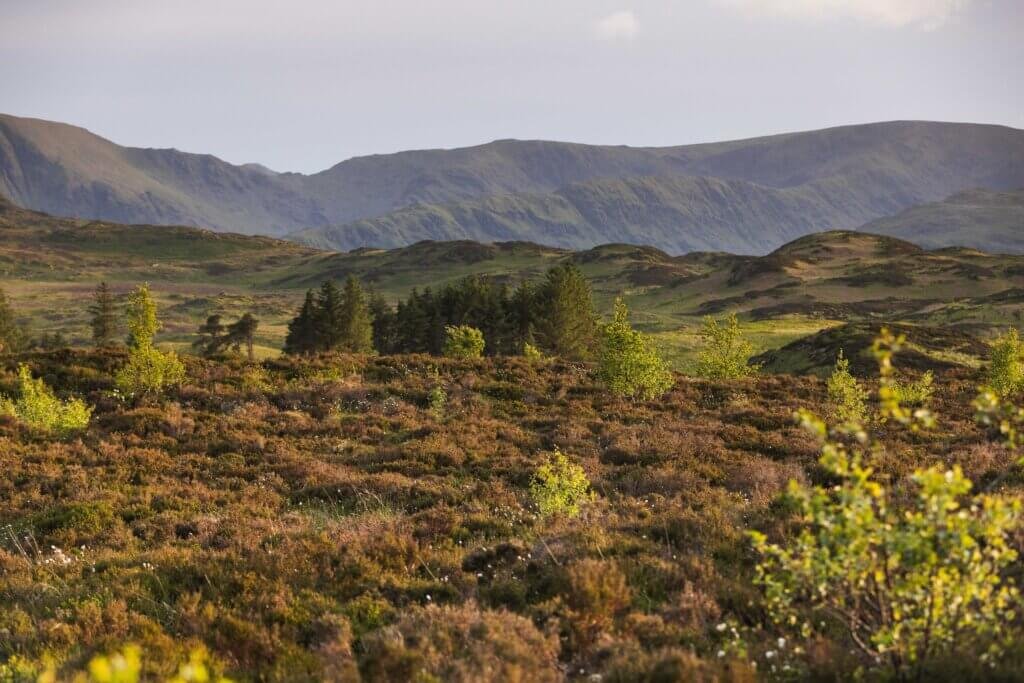
The research is supported by the Endangered Landscapes & Seascapes Programme through its Advancing Restoration Knowledge Grant scheme. It will explore how mycorrhizal fungi, microscopic soil organisms that form essential partnerships with tree roots, influence woodland creation in the UK’s upland fringe, the transitional area between upland fells and lowland farmland, where restoration can be particularly challenging. The work will offer one of the most complete pictures yet of how upland landscapes respond to ecological restoration above and below ground.

The research comes as the UK faces ambitious woodland creation targets. England alone has committed to creating around 260,000 hectares of new woodland over coming decades, with planting steered away from high-grade farmland and sensitive peat soils. This has placed growing emphasis on the upland fringe to deliver nature recovery and new treescapes at scale.
Yet woodland establishment in these landscapes can be variable. Even where grazing pressure from sheep, cattle and deer has been reduced and planting follows best practice, tree survival and growth differ widely between sites, suggesting that the recovery of below-ground conditions may play a more important role than is currently understood.
While the importance of mycorrhizal fungi for tree growth is well established, their role in shaping restoration outcomes in long-grazed upland landscapes is rarely examined at scale.

The research will take place across Wild Haweswater, a landscape restoration partnership between the RSPB and landowner United Utilities, and surrounding upland landscapes. Naddle Forest, one of the UK’s last remaining fragments of temperate rainforest, will be used as a reference for long-term ecological recovery. It will be led by Dr Mo Verhoeven, Lead Conservation Scientist for Cumbria Connect, in partnership with the Society for the Protection of Underground Networks (SPUN) and the RSPB.

Dr Mo Verhoeven said: “We know mycorrhizal fungi act as an underground support network for trees, but we still don’t know when missing fungal communities become the factor that limits restoration success in upland landscapes. This project allows us to test that directly and to understand how below-ground recovery reacts with changes in grazing management and tree planting.
Our fieldwork across Cumbria’s upland fringe will combine soil DNA sequencing, long-term grazing trials and nursery inoculation experiments to understand which fungal communities are present, which are absent and how we can rebuild them.”
The study will map mycorrhizal fungal communities across different land uses and management histories. It will examine whether soils dominated by fungi that is commonly associated with grasses and herbs and is common in grazed landscapes (called arbuscular mycorrhizal fungi), shifts towards fungi that is associated with trees (known as ectomycorrhizal fungi) as restoration progresses. It will also look at whether that shift happens naturally or requires targeted support. A plant nursery experiment will test whether locally-sourced soil inoculation, containing mycorrhizal communities from temperate rainforest, improves the survival and growth of native trees such as oak and birch once planted into the landscape.

Bethan Manley, Lead Computational Biologist at SPUN, said: “Findings from the research could feed into a practical toolkit for considering mycorrhizal fungi in restoration projects, offering new evidence for land managers, restoration partnerships and policymakers across the UK and beyond. The aim is to improve confidence in woodland creation, reduce uncertainty and support more effective investment in nature recovery by working with natural processes.”
Cumbria Connect is a landscape-scale nature recovery programme funded by The Endangered Landscapes & Seascapes Programme. It is a growing partnership of farmers, landowners and conservationists including Lowther estate, the RSPB, United Utilities and Natural England, working together to support nature-friendly farming, restore natural ecological processes and address the biodiversity crisis.

ENDS
[registration_form]
Source link