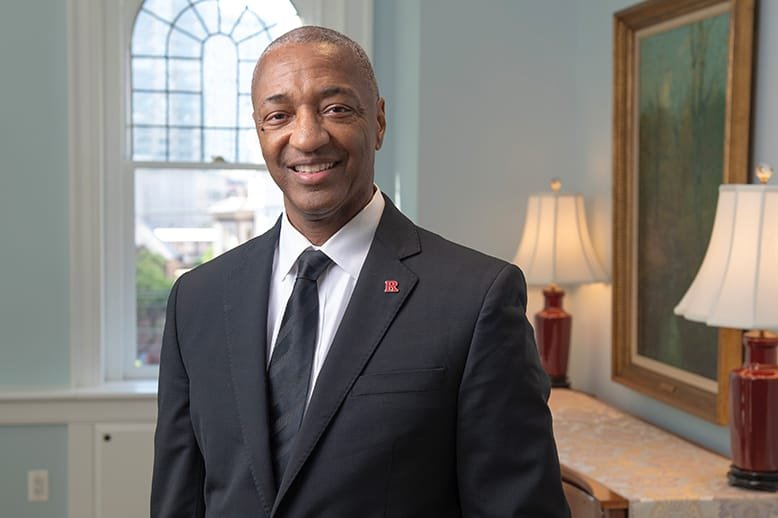
William F. Tate IV started his new position as the 22nd president of Rutgers University this summer. Formerly president of Louisiana State University, Tate, 64, is a nationally recognized social scientist and has taught sociology, psychiatry and epidemiology. Tate will be Rutgers’s highest-paid president, with a $1.1 million base salary. He grew up in Chicago and is married to Kim Cash Tate, an author, Bible teacher and speaker.
How did your upbringing shape who you are now?
I grew up in Bronzeville on the South Side of Chicago, with all the wonderful assets and challenges associated with urban communities. My constant curiosity is in part a credit to my paternal grandmother, an educator, who responded to my questions by promoting visits to the Museum of Science and Industry and other informal educational experiences. My mother worked in an academic medical center. She would share copies of JAMA [Journal of the American Medical Association] during my youth. This early exposure was powerful. Prior to moving to the nonprofit sector, my father worked for Fisher Scientific, so he shared science kits, telescopes and microscopes. He loved to read and debate. I am a product of his contests. My maternal grandparents insisted that I attend Catholic schools for my elementary and high school years, where I developed academic discipline and was taught the importance of serving others. And passionate discussions with my friends and classmates were a regular part of my life, shaping my appreciation for great arguments that use story, evidence and reason.
What attracted you to Rutgers, and what convinced you to take the job as president?
The search committee did a spectacular job as ambassadors for Rutgers. They introduced me to the outstanding quality of the faculty across so many areas, and I was convinced that Rutgers stands at the edge of something extremely special.
What are some of the main challenges you will face at Rutgers?
New Jersey demands excellence. We have an opportunity to expand social mobility and increase access to education across the state in an affordable fashion. In our partnership with RWJBarnabas Health, we are driven to enhance our national model of evidence-based cancer care and life-changing biomedical research in the areas of cancer, brain health and cardiovascular health. To better compete for our top students in New Jersey, we must expand our honors colleges and business school, maintain the high quality of our humanities, social science, and professional programs, and continue to recruit and retain outstanding faculty and staff.
How do you plan to deal with federal funding cuts to Rutgers, and the loss of some of its international students?
A university always must be ready to adjust the funding mix; one year, it could be a downturn in state appropriations, for example. The one thing we never want to do is price our students out of a Rutgers education. So it is important to be flexible in our ability to reallocate resources to the students. Social mobility is one of our greatest strengths, across all campuses. We are committed to being top ranked among our peer institutions with respect to being a place that positively impacts our students’ destiny. And just to be clear about our international students: Our enrollment for fall 2025 is more than 6 percent higher than a year ago.
What are some goals for the school?
My aims will center on ensuring that Rutgers creates cycles of opportunity for our students and communities. Rutgers is a tremendous driver of social mobility for students from all zip codes, who become engaged and successful citizens and, in turn, contribute to their communities by creating innovations and opportunities that improve life for others in New Jersey and beyond.
I believe we can move higher in the public university rankings: top 40 for Camden, top 30 for Newark, top 10 for New Brunswick. This effort is driven by our commitment to improve attrition rates, graduation rates and social mobility.
At LSU, you oversaw significant growth in research spending. Is that something you plan to work toward at Rutgers, too?
Yes, we will continue to push for a growth in funded research activity. You see the faces of the people of New Jersey in our research: food security, cancer research and interventions, environmental and coastal modeling, drug discovery, biomedical and civil engineering, and social policy research. Rutgers scholars in agriculture, biomedical science, engineering, basic and clinical science, education, and many applied fields are working to improve society. Rutgers has secured nearly a billion dollars a year in research funding. And our research funding increased in fiscal 2025 despite federal research-funding policy changes.
What are some changes that Rutgers faculty and students will see going forward?
Aggressively seeking partnerships with the state’s business, government, and medical community that build on our research and create new opportunities for our faculty to take their discoveries and innovations to the next level. Setting clear goals and measuring progress toward them. For students, we’re launching the Edge Fund, a scholarship that rewards those whose areas of brilliance, such as artists, coders, writers and competitors in non-revenue sports, bring impact and excellence to Rutgers.

That summer gave me the confidence to aim a little higher for myself.
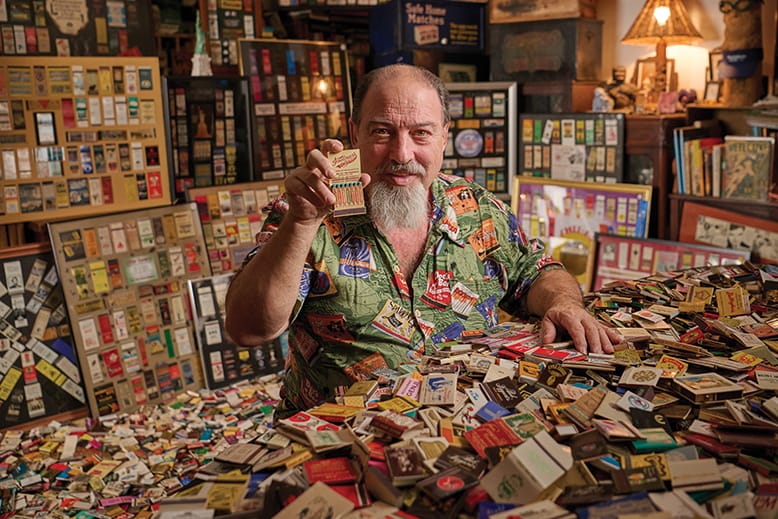
Richard L. Greene has a massive, 750,000-matchbook collection with thousands of New Jersey match covers.