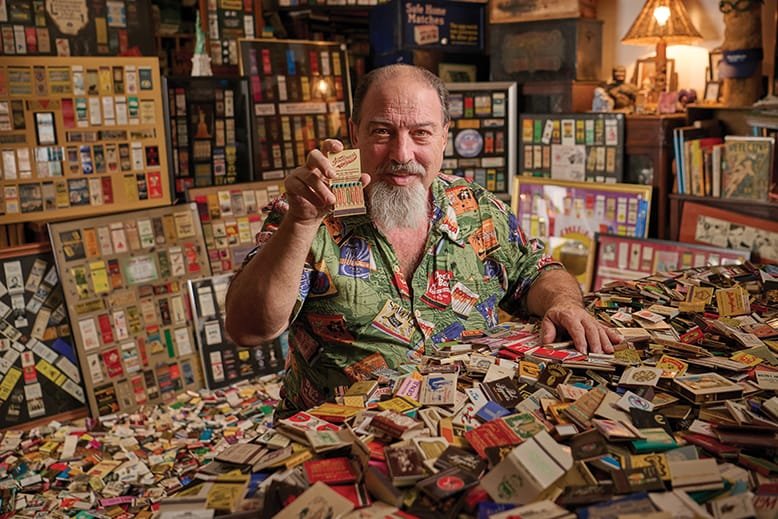
Collingswood’s Richard L. Greene is a match-industry historian, incomparable collector and vice president (and former president) of the Liberty Bell Matchcover Club. On this summer day, he’s just returned from an estate pickup in Brick, where he scored 45 3- to 5-inch, clean, categorized and labeled binders of plastic-sleeved match covers, mostly on Garden State subjects.
He’s toted some of that cache to a meeting and summer picnic at fellow club members Jim and Christy Benes’s home in Middlesex. Combining it with some of his own collection, plus examples from another recent estate acquisition in Columbus, Ohio, with fellow club officer Robert E. Lamb Jr., there’s a flicker of a show-and-tell. “We rented a Chrysler Pacifica in Ohio and loaded it,” Greene says.
A week later, these aficionados traveled to the 84th annual national convention of the Rathkamp Matchcover Society (RMS) in Mars, Pennsylvania. Beforehand, Greene tapped the only independent match manufacturer’s representative left in New Jersey, Joe Danon, founder and president of the Match Group in North Caldwell, for two custom sets to celebrate RMS and Liberty Bell.
“I’ve had a passion to keep this going,” says Danon, first a collector, then an industry icon. “Now, we’re looking past every common business that advertised on matches and pushing into musicians, artists, candle companies, and other start-up Etsy-type at-home businesses to meet the social media explosion head-on.”
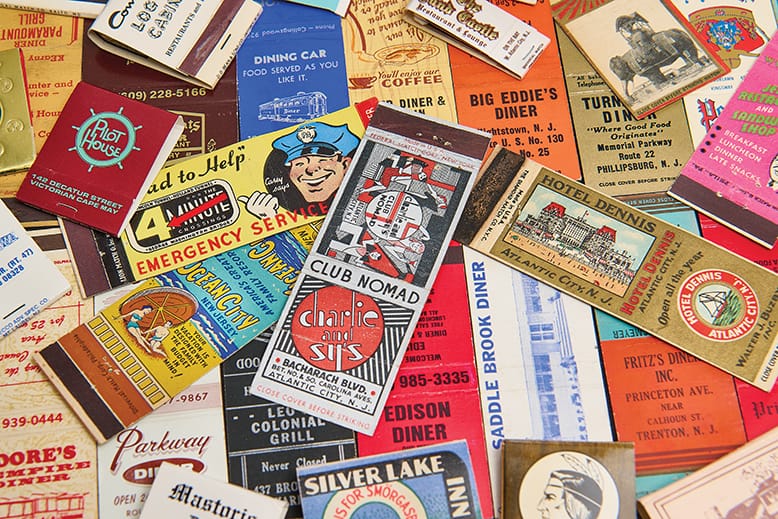
Greene’s collection features thousands of historic Jersey match covers, many from the Shore. Photo: Dave Moser
After the friction match—a household and smoker’s essential—was invented in 1826 in England, small match companies sprang up all over North America. Almost all were absorbed by the Diamond Match Trust Company, formed in 1881.
Liberty Bell holds meetings all over South Jersey, largely where its leadership resides. President Fred Costanzo lives in Trenton. His collector’s business card is a caricature portrait of himself on a matchbook.
“The buy-in is cheap; survival is not,” he promises of the hobby.
Greene, whose massive, 750,000- matchbook collection once earned him a segment on CBS’s Sunday Morning, has thousands of New Jersey match covers. He has an album of Shore covers (even one for a defunct nudist resort, Sunshine Park in Mays Landing); another binder with fire-company covers; another of South Jersey nightclubs and pubs; and other Jersey covers among 120 binders titled “Famous Buildings,” “Amusement Parks and Rides” and “Diners.”
“What’s more New Jersey than a diner?” he asks.
Marc Edelman, a fellow mega-collector and the editor of the club’s newsletter, the Liberty Bell Crier, has a framed diner display that is heavily New Jersey influenced. It includes Madison Plaza in Paterson, Trent Diner in Trenton, Blue Star Diner in North Plainfield and Sunset Diner in Bound Brook.
At the summer meeting at the Benes’s home, it’s apparent that New Jersey has a large part in keeping this hobby alive. “In this yard, you probably have four of the top 10 collectors in the world,” Edelman notes.
The hosts’ basement is largely full of Jim’s girly-matchbook collection, which Christy tolerates. Poolside, the club is sorting its recent hauls.
“The system we have is simple: Have we seen the cover 100 times before?” says recording secretary Sherry Sisson, who lives in Westmont and craves covers featuring South Jersey establishments.
With acquisitions, the goal is to keep new materials in the club and hobby first. Pickers’ rights go to meeting attendees; then, the extras are available via online auction. The bulk excess goes to shows and conventions on free grab tables.
“We pool collections and pull for each other,” Sisson says.
Edelman’s 60-year obsession began at age eight. He still spends three or more days 50 weeks a year hunting flea markets, antique shows and shops.
Greene’s been at it since the mid-’70s. His curated covers, which total over a quarter million (plus another half million unsorted) include the extraordinary, like those commemorating aerospace missions, and the unusual, like a radioactivity category for covers commemorating nuclear energy, radiation, X-ray equipment, uranium mining and more.
Years ago, when everyone smoked, a matchbook was a no-brainer small, effective advertising canvas. These mini-billboards have become historical and educational documents.
“You can document the history of almost anything with matchbooks,” Jim Benes says.
“But you also couldn’t be in business without a matchbook ad,” Greene chimes in.
Greene, a 73-year-old, self-described “compulsive collector” who grew up in Sewell in the ’50s, is drawn to the eye-candy graphic arts of matchbooks.
Greene’s favorite is one his mother gave him that celebrates Neil Armstrong’s Apollo 13 moon mission. It’s autographed by Armstrong, obtained with the help of his father, an aerospace engineer when RCA’s Defense Electronic Products group was in Moorestown. He recently purchased one signed by John Glenn. “So I have a matchbook to celebrate the first in space and the first on the moon,” Greene says.
“Anyone can do this. You just have to be passionate,” he says.
But he and his fellow club members are old-school—Edelman doesn’t use email or the Internet—and the flame of the hobby may be going out. RMS, which once had 5,000-plus members, is down to 1,000. Liberty Bell has about 460 Facebook members, but just 80 (30 in Jersey) who pay dues. ( The only other New Jersey club, the Garden State Matchcover Club, is sputtering and members now attend Liberty Bell meetings.
Less than a dozen people gathered at the July meeting, and among them, only Mount Laurel’s Steve Gilbert, a founder who has held every club office, can speak about Liberty Bell’s beginning in 1982.
“My wife decided I needed a new hobby,” he says, remembering a Family Circle magazine ad that listed options, including a match club.
However, the face of the matchbook collector is changing and, since 2004, Danon, of independent match manufacturer the Match Group, has become a striker.
For one, he’s re-popularizing the feature match, a concept that Lion Match pioneered in the ’30s. These retro matchsticks were (and again are) crated in the shape of featured subjects—say, Mr. Peanut to promote Planters Peanuts, or a beer bottle to celebrate a brew, or fountain pens, or even artificial limbs during wartime years.
The Match Group is drawing a younger TikTok- and Instagram-user clientele and collector with a no-limitations technology that’s allowing customization to flourish.
“We’ve found we can make cool even cooler,” Danon says. “All social media is blowing up with matchbook posts. The demand’s there, so a whole secondary market is blossoming.”
Thankfully, old-time collectors remain, Danon says, but many are “set in their ways and stuck in a certain demographic.”
Looking toward the future, he says, “My company’s bringing in fresh blood and keeping the hobby alive.”
The Peacock show stars Emilia Clarke from Game of Thrones and Haley Lu Richardson of The White Lotus.

The pooches are all rescues looking for their forever homes.