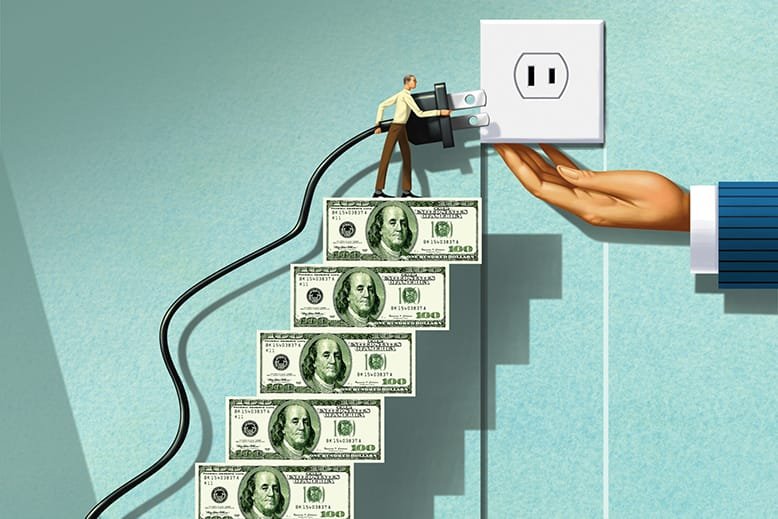
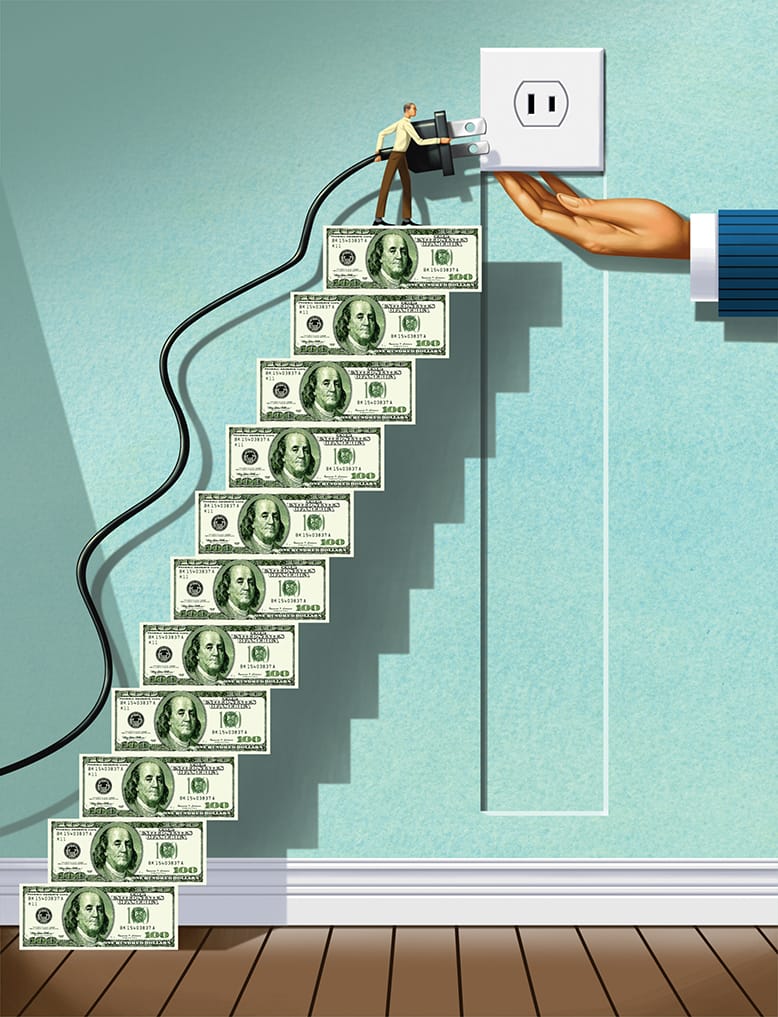
Illustration: Jim Tsinganos
It was a cool, overcast day in August when television crews started showing up on a sleepy residential block in suburban Kenilworth.
There, standing outside the tidy red-brick ranch house of Herb and Mary Michitsch, Mikie Sherrill made what was probably the boldest pledge of her campaign for governor: a day-one freeze on electric rates across the state.
“New Jerseyans are hurting,’’ she said.
To prove her point, Sherrill introduced the Michitsches, retirees in their late 80s, who revealed that their electric bill had risen to nearly $400 a month, quadruple what it was when they first moved to their home more than 50 years ago. “It’s uncontrollable,’’ said Herb Michitsch. “Something really has to be done.”
All over New Jersey, people like Michitsch felt shock waves last summer after their power bills shot up some 20 percent practically overnight. Anger and recrimination spread far and wide.
Republicans in Trenton blamed the overnight cost crisis on Governor Phil Murphy, the two-term Democrat whose ambitious plans to power a million homes from offshore wind farms collapsed amid waning public support.
Democrats blamed PJM Interconnection, an obscure agency headquartered in Valley Forge, Pennsylvania, that manages the electricity grid for New Jersey and 12 other states, from Tennessee and Kentucky to Delaware, Maryland and Michigan. The organization, they argued, is a black box that stacks the system in favor of big fossil-fuel producers and against consumers.
As part of its duties, PJM tries to predict future energy use and then auctions off capacity to power companies. Critics say the auctions are hopelessly flawed and complex.
“There is no doubt about it: The big price we’re seeing for power is driven a long way by PJM’s closed-door, self-serving policies,” says Bill Wolfe, a former New Jersey state environmental regulator who tracks the agency.
*
One thing both sides agree on: Energy consumption will continue to soar across New Jersey and the high-tech corridors of the Northeast as investors pump billions into artificial-intelligence technologies.
While Mikie Sherrill and Herb Michitsch were staging their press conference in Kenilworth last August, executives at the CoreWeave corporation about a mile away were preparing to begin construction on a $1.8 billion, 392,000-square-foot data center for cloud computing driven by artificial intelligence.
With a power capacity of 250 megawatts of electricity, the CoreWeave data center could suck up enough energy every year to power more than a quarter-million homes, according to data from the International Energy Agency, a nonprofit public policy organization.
The Nebius Group, a Dutch AI company, is planning to build an even more powerful data center that will sprawl over 2.6 million square feet in Cumberland County.
These are only two of the 114 data centers built or approved for construction in the Garden State, according to the website datacenters.com.
But even as showy projects like CoreWeave’s take flight here, there is concern that the Garden State is not prepared to cash in on the AI investment bonanza that pumped more than $350 billion into the U.S. economy last year alone.
Analysts say nearby states like Pennsylvania and New York are poised to outcompete Jersey in the AI race simply because they have more ready power. For much of the past decade, they say, Jersey was shuttering coal- and gas-fired power plants to focus on renewable energy sources while its neighbors took a more even-handed approach.
Murphy’s no-regrets policy to develop alternative fuel sources called for reaching 100 percent clean energy by 2035, mostly through offshore wind and solar generation.
But local opposition to wind farms off the Jersey Shore mounted rapidly. Investors who were originally gung-ho on Jersey wind, including the giant Danish corporation Orsted, grew skittish. “We bet the farm on wind and lost, and now we don’t have a plan B,’’ says Matthew Hale, a political science professor at Seton Hall University who studies New Jersey politics and policy. “We’re paying more for electricity because we simply aren’t making enough of our own.”
*
Hale has analyzed a decade of energy data for New Jersey and the surrounding states. Late last year, he published an eye-popping study, Dollars and Decisions: An Examination of a Decade of Energy Policy Decisions by New Jersey, New York and Pennsylvania, which confirms what people already felt in their pocketbooks.
The study found that residential electricity customers in New Jersey have seen the highest rate increases in the mid-Atlantic region and among the highest in the nation. The average household now pays more than 51 percent more for power than it did in 2015, some 15 percentage points above the national average.
New Jersey’s rate increase dwarfed hikes in neighboring New York and Pennsylvania. And while our neighbors were also spending huge sums to develop solar energy and wind farms, they also kept a stake in tried-and-true fossil-powered plants.
“I think the record is clear: Balance is best,” Hale says. “Of course we need to address climate change and move to renewable power. Everybody wants coal plants to be shut, but the question is, what do you replace them with?
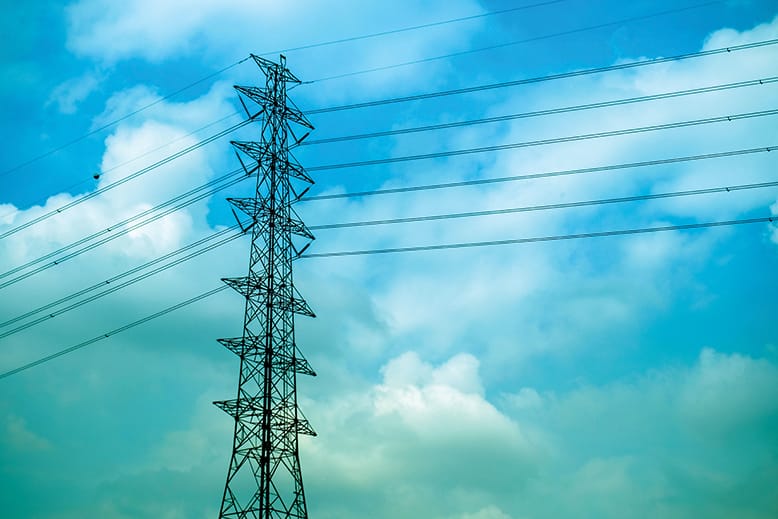
Photo: Shutterstock/ChirsKim
The solution to that tricky question now lies with Governor Sherrill, a Democrat who talked a tough game on utility rates as she ran up a landslide win in November.
In addition to a freeze on rate hikes, Sherrill promised to “massively” expand cheaper and cleaner power generation to build a Jersey “energy arsenal.’’ She pledged to crack down on utility firms and force them to open their account books. And she vowed to get tough with PJM.
“I will force our grid operator, PJM, to end its years of mismanagement and add power immediately,” she said last year.
PJM has pushed back hard on the criticism and claims its management of the power grid has saved money for New Jersey ratepayers.
The agency points out, too, that it has accurately predicted rising rates for years and foresaw the AI mania now driving prices.
Greg Lalevee is business manager for the 7,000-member Local 825 of the International Union of Operating Engineers. Working men and women in New Jersey, he says, should not have to bear the brunt of failed state policy.
He worries that the new governor might focus too much on outside factors like PJM and too little on developing reliable homegrown power.
“I don’t know if she will be able to just declare an energy emergency and freeze rates,’’ Lalevee says. “And even if she does make a freeze work, we still have a long-term energy problem in New Jersey.’’
One weapon certain to play a big part in Sherrill’s energy arsenal is nuclear energy. Progressive governors around the country, most notably Democrat Gretchen Whitmer in Michigan, have authorized millions in taxpayer subsidies for new reactor projects.
Last year, lawmakers in Trenton advanced a plan that would allow the Camden-based Holtec International to build a pair of so-called small modular reactors, or SMRs. The plan to build the new high-tech mini nukes will rely on big public subsidies, likely running into the tens of millions of dollars in the near future.
Critics say betting on a new generation of untested nuclear technology is folly.
“It will take years and millions in public treasure to get new reactors up and running,’’ says longtime NJ Sierra Club head Jeff Tittel. “All those resources should be going to the development of renewable power. That’s the only sensible path forward.’’
State Senator Bob Smith (D-Piscataway), a noted environmental advocate who is behind the plan for new reactors, says New Jersey simply has no better choice at a time when rising costs and climate change are wreaking havoc.
“The end of the world is coming soon, we need to find carbonless fuel, and right now things are not going well for renewables,” Smith argued during a recent committee hearing in Trenton.
“Our citizens will not stand for us not having a source of electricity in this state,” he said. “We have to change the dynamic.”
Jeff Pillets is a contributor based in Trenton who has covered the state for more than 25 years and has won numerous honors; in 2008, he was a Pulitzer finalist.

Our magazine has been championing Garden State stories for half a century.

Revisit highlights from our rich history!