Opinions differ as to how and when one ‘should’ take down Christmas decorations, just as they do about how and when one should take down Venezuelan presidents. But on the former I stick to the Twelfth Night rule which gives me an opportunity to have a look at all the Christmas cards that have arrived.

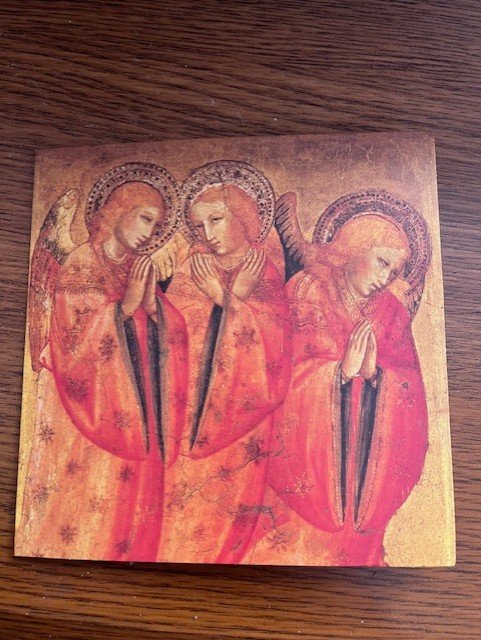
Personally, for me, the perfect and idealised Christmas card has a religious link and preferably was produced by an Italian more than five centuries ago, so the detail from ‘St Peter and St Paul with Angels’ by Olivuccio di Cicarello de Camerino (c1400) ticks those boxes (and sales of it go to the Fitzwilliam Museum in Cambridge – a good cause). This isn’t because there are any vestiges of religious belief left in me but one has to hang on to the real meanings of some things.

However, this modern rendition of a Christmas tree by our eldest grandson who started school in September comes a close second, and was produced, at his Hull school, on a card ‘carbon balanced’ by the World Land Trust as an extra.
But I also review the creatures on Christmas cards each year. Now, the people who send us Christmas cards know that they are sending cards to people interested in wildlife, and if they are sending us Christmas cards at all then it’s likely that they have more than a passing interest in wildlife themselves.
The bare figures show the usual inversion of ecology with large numbers of mammals; Badger 2, Red Fox 2, Arctic Hare 2, Arctic Fox 1, Polar Bear 1, Rabbit 1, Brown Hare 1, Fallow (?) Deer 1 and a cheerful-looking but rather foolish Hedgehog ploughing through the snow.
The domestic animals are; Sheep 12, Reindeer 5, Pigs 2, Cattle 2, Horse 1, Donkey 1 but, very surprisingly, not a camel to be seen.

Turning to birds, Robins have had a poor year with just two, perhaps because Ravens 6 and Penguins 5, crowded them out. There were single Barn Owl (interestingly dark-breasted), a dove of peace, Red-legged Partridge (yep, in a Pear Tree) and two very well-drawn (by Liane Payne) Waxwings in a Hawthorn with willow sp in the background (an RSPB card also carbon-balanced through World Land Trust).

But the most arresting wildlife Christmas card of all was this one (home produced by someone whom I have yet to meet face to face) with its variety of geometric shapes. The dark triangles are Staurastrum vestitum (from NW Iceland), the light triangles Staurastrum maamense from Cumbria whereas the base is Melosira varians from Pitsford Water, Northants and the star Pedistrum simplex from Castle Ashby, Northants. So the single-celled aquatic algae have it!
[registration_form]
Source link