
If your New Year resolution is anything to do with seeing more wildlife, becoming a little better at identifying what you see or getting to the top of the list of individuals who have seen the most species of wildlife in the UK then this book is for you.
The author is widely recognised as one of the very best all-round naturalists in the UK in terms of fieldcraft and identification skills. He is the county recorder for spiders and bugs (both difficult groups) for both East Sussex and West Sussex so he is embedded in the biological recording community. I have got to know Graeme well over the past year as he has given me lots of help in my 2025 house and garden bioblitz. In the field, in my case my garden, he is astonishingly sharp-eyed and sharp-eared and I feel exhausted just trying to keep up with him (despite failing to do so). Many other highly talented naturalists, many of them wildlife consultants (as is Graeme), speak in awed tones of Graeme’s abilities to find and identify species.
Pan-species Listing is the equivalent of keeping a bird list (for some defined geographical area) but not sticking to birds, or vertebrates or animals but including all taxa. Paying attention to all species means that you may take as much pleasure from finding and identifying a new beetle that you almost step on in the nature reserve car park as you do from seeing the nesting pair of Ospreys at the nature reserve. And a beetle, an ant, two or three plants and a moss may fully compensate you if the Ospreys have gone missing during your visit.
This book is there to encourage you to look more widely across taxa and not to feel happy in your comfort zone of relative expertise in one area, be that flowering plants, birds, moths or cnidarians. Having begun to follow that route myself I can see that this book will not only encourage others to take the same journey (the author is an enthusiast) but also help others (the author is very knowledgeable). He provides links to societies, field guides, keys and reference works that will open up these new world’s with as little pain as possible.
There is a website https://panspecieslisting.com/pan-species-listing-psl-uksi.html which lists all 75,000 UK species and where you can look up the life lists of those who have bothered to put them on that website and add and update your own. Graeme Lyons is the second-highest ranking person with well over 9,500 species. How many UK species have you seen? It might be fun to check, and it might be fun to decide to add 100 species this year as that will get you out into the countryside exploring nature. I’ll tell you now, that if you start by planning to add 100 species in 2026 you will probably add far, far more as you realise how easy and rewarding simply looking with a wider purpose can be.
Much emphasis is given to submitting your records so that they can be assimilated into the corpus of knowledge. If you find an interesting species in your street then the relevance of that to others is zero if they know nothing about it but may grow with time if it is a verified record with a date and a location. What the book doesn’t make so clear is that getting your record into the system varies in ease depending on taxon and geography – it’s a bit of a post-code lottery as to whether the system works near you.
We learn of the author through this book. What sort of person has a pan-species list of well over 9000 UK species? In this case it’s a man in his forties who has been carrying out wildlife surveys for decades, has been interested in wildlife all his life, had a difficult childhood and was only recently diagnosed with autism and attention deficit hyperactivity disorder. Graeme makes no bones about the fact that he has prospered at being a naturalist because of rather than despite being AuDHD. He writes “Being AuDHD is a hugely positive factor for my work, and is probably the reason I am doing what I am doing – it’s like a superpower on that front. I know I have an unusually retentive memory, which helps a great deal.” and the less welcome consequences of AuDHD mainly manifest themselves outside of his work when interacting with people.
There is a lot in this book; it is part autobiography, part instruction guide, part enthusiastic advertisement for a way of looking at the natural world and it is all written with humour and clarity. Few have the knowledge to cover so much ground and even fewer have the ability to write so well. This is a ground-breaking book which is also useful and fun. It will, with no doubt, be one of this blog’s books of 2026 even though it is the first book to be reviewed here in 2026.
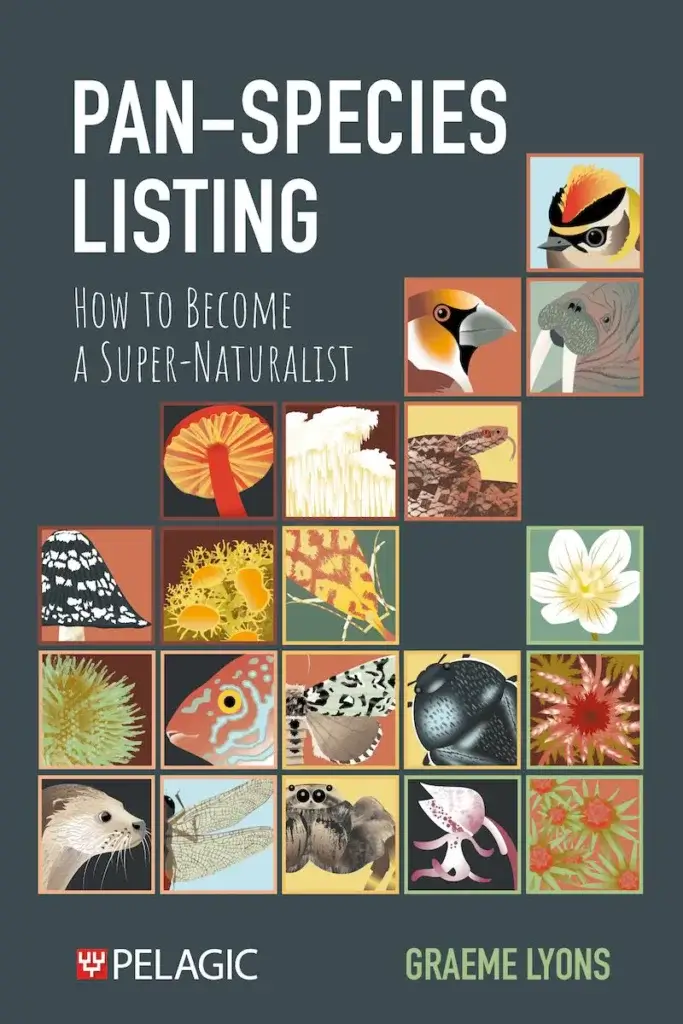
The book cover? The cover is by Rachel Hudson (who produced the cover of my book Reflections) and it is very attractive and very appropriate. I would always put Rachel Hudson in my short list of artists to consider for natural history book covers and I give this cover 9/10.
Pan-species Listing: how to become a super-naturalist by Graeme Lyons is published by Pelagic (on 26 February).
[registration_form]
Source link